Prose Poetry, September 2026
Following the launch of each of our issues, we cajole one or more of the contributors into a mini interview with the Trash Cat.
Here they will reveal some writing wisdom and tell you what trash critter they identify with most. Important stuff like that.
Today, we have Gill O’Halloran and her remarkable hermit-crab poetic prose piece. Read Living Well in Later Life.
Q: What piece of writing advice/ crafting rule would you trash?
A: I’d trash the idea that you mustn’t confuse the reader. Sometimes I get feedback saying, “I didn’t understand this,” or “I need to know more about why they did this.” And sometimes I think: no, you don’t. But you do need to relate to it. I don’t think I have to explain every action, motivation or meaning. There can be gaps. You don’t have to fully understand something to feel it. Sometimes that’s where the story lives – in the overlap with poetry.
Q: Which writers and magazines do you go to to find treasure to read?
A: I love Lorrie Moore’s early funny-but-tender short stories, Elif Shafak for her rich narratives and attention to marginalised voices, and books with beautiful language like Ocean Vuong’s On Earth We’re Briefly Gorgeous. But I also like more mainstream authors like Robert Harris because he makes complex historical/political ideas accessible and gripping. And I love sci-fi, love Ian M Banks’ Culture novels.
For flash, I particularly rate Claudia Monpere for her stunning lyricism and surreal conceits, Gillian O’ Shaughnessy for her visceral, atmospheric settings, JJ Pena, for how he writes about sex with emotional vulnerability, and Travis Flatt for his mastery of humour and dialogue. I read many flash lit mags: Neither Fish nor Foul, Trash Cat Lit, BULL, Fictive Dream, Claudine, Bottle Rocket, Full House Literary, are among my favourites.
Q: What trash animal do you most identify with?
A: I think I originally said puffins, or was it gannets? (It was an octopus, TC) But that’s more because I love them than identify with them. Sticking to birds, I’m probably a ring-necked parakeet, (the UK’s only wild, naturalised parrot). They’re not sure if they quite belong, but then they don’t do much to blend in, and other birds might unkindly think them rude. They’re survivors, and they seem to have a knack for making a life wherever they find themselves. And they get drunk very easily!
Q: When your writing mojo is trashed, how do you recharge?
A: My writing mojo was well-n-truly trashed this summer when my cat died and at the same time I had a relentless stream of rejections. I stopped writing for nearly a month, spent time in nature, listened to lots of music, live music and Spotify, and focussed on singing for a large choir event. Then one day I just started writing again. I knew it wouldn’t desert me. On a day-to-day basis, SmokeLong Fitness gives me the discipline (and prompt) to write a new piece each week.
Q: If you could offer three tips to writing short treasures, what would they be?
A:
1 – You can write the most familiar stories if you write them oddly enough. But it must have a moment of universal resonance.
2 – Become one of your story’s characters and write a separate piece through their eyes. What do you most want? What’s stopping you getting it? What doesn’t the author understand?
3 – When editing, highlight your verbs and replace them with less obvious words. Obviously that applies to language generally but I think verbs in particular benefit.
Q: What is one thing, if spotted in a crowded charity shop/thrift store, you would just have to buy
A: Colour is what draws me in – if it’s turquoise I’ll likely pick it up, whether it’s a jumper or a potato peeler.
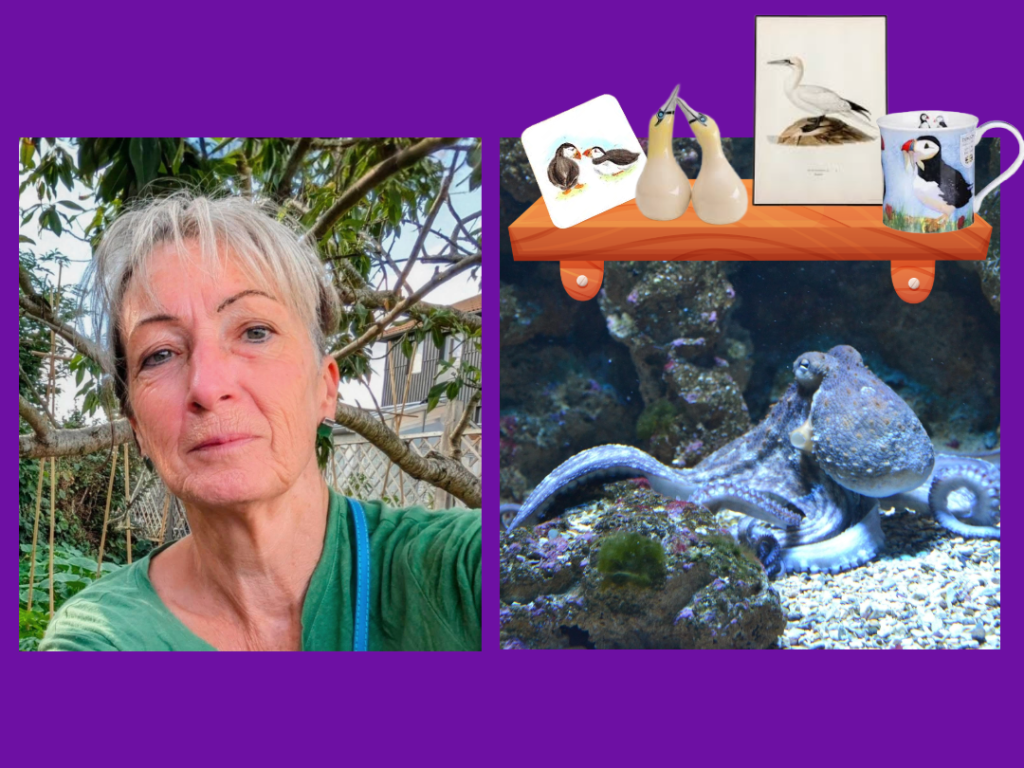
Gill O’Halloran is a lido-loving Londoner. First published by Trash Cat Lit, she won the 2025 NFFD Anthology Editors Award and features in its 2026 anthology. Her work appears in SmokeLong Quarterly, New Feathers, BULL, JMWW, Flash Boulevard, Bath and Oxford anthologies. Winner of Westword and Flash500, her poetry collection was included in the Top 20 Small Press Poetry list.
