Claudia Monpere
Listen to Claudia read her story
When The Rooting first happens, our devices continue without us, security systems chiming they need new batteries, Siri reminding us to pick up milk. Our homes look just as they had. But soon—Maybe soon? What is soon? We have no sense of time anymore—walls and floors crumble. Ivy swallows our collapsing roofs. Periwinkle and honeysuckle climb our walls. Instead of being rooted in linoleum or tile, our feet are in soil.
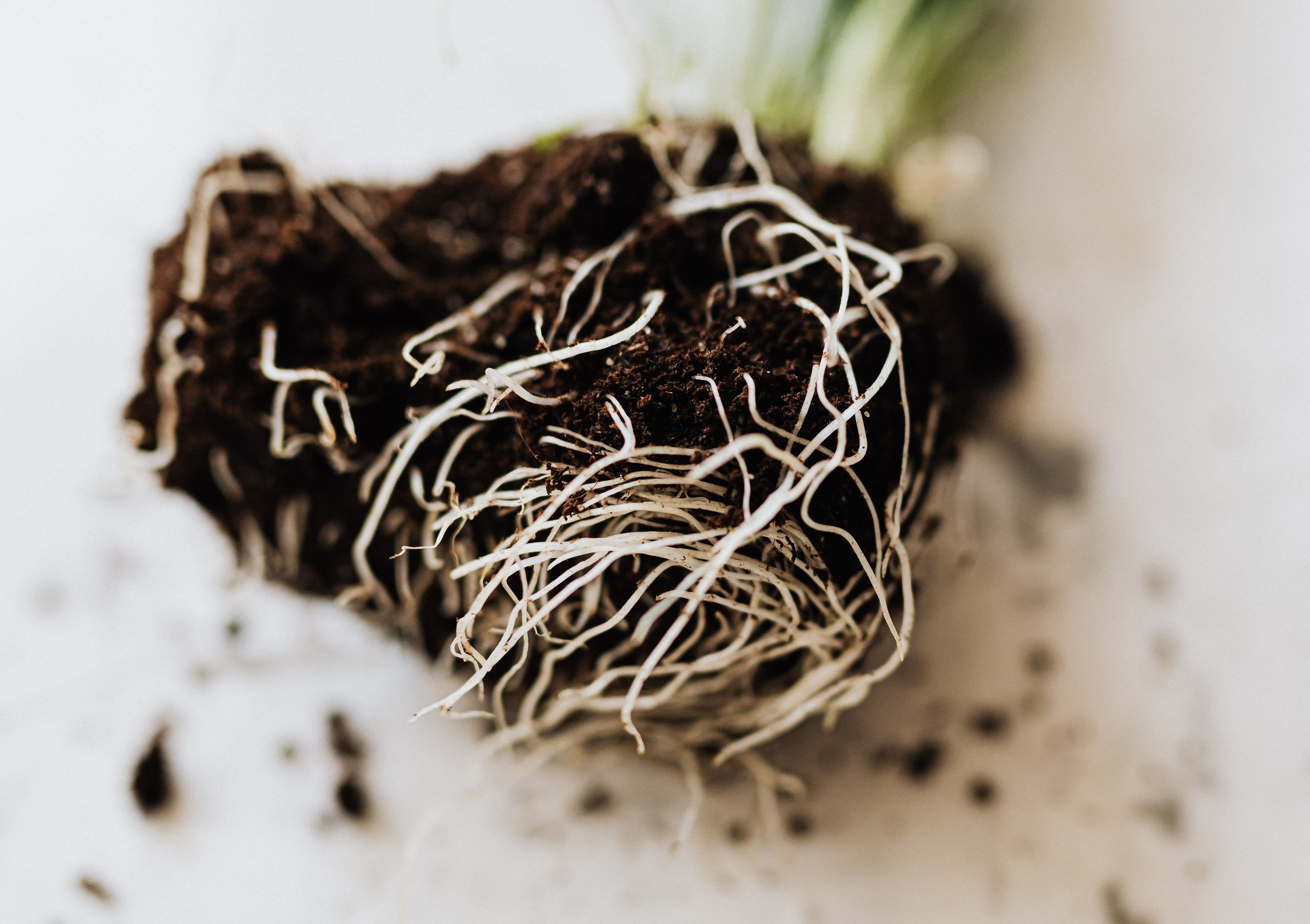
Some of us have tap roots, penetrating deep into the ground. Others have fibrous roots, shallow web-like structures reaching wide.
Some of us try to find meaning: Earth’s revenge for us polluting the soil with pesticides and fertilizer, mining and industrial waste. There’s some merit to this theory. Certainly drilling rigs have stopped drilling. Dragline excavators and wheel tractor scrapers don’t dig. Hydraulic fracturing pumps don’t pump.
Our children adapt quickly, communicating through mycorrhizal networks, sharing moisture and nutrients, warning of drought or predators. You see, we’ve lost not only our movement but our voices. But we let the children teach us and soon there are many connected communities.
We try to ignore those of us driven by hierarchy. The Taprooters: We’re more stable. We’re better at withstanding drought. The Fibrous: We absorb water and nutrients more quickly! We’re better at filtering out pollution. We can communicate greater distances.
Some of us think it’s God’s punishment for our wicked ways. Some insist it’s a conspiracy. But some of us—and all the children—rejoice when wind and rain tear off our clothes or sun glows us with a buttery warmth not felt since we tumbled and floated inside our mothers.
Where did our memories go? Those of us with taproots have a hazy overview of our past lives but one striking memory that will not leave us, that appears fully formed, cascading sensory details. It dazzles or haunts us. Those of us with fibrous roots can remember many events and feelings. But we have no truly episodic memories. Is one way of remembering better or worse?
And new memories, those since The Rooting? We are still trying to understand. When a wood thrush perches on us and sings her fluted song, when roots we thought of as strangers send us badly needed nitrogen and carbon, when the sky offers us star glint and moon pearl, peony clouds and blue shimmer, who can distinguish now from then? Who would want to?
Claudia Monpere lives in the San Francisco Bay Area. Her flash fiction appears in SmokeLong Quarterly, Split Lip, Trampset, Flash Frog, and elsewhere. She won the 2023 SmokeLong Workshop Prize, the 2024 New Flash Fiction Prize from New Flash Fiction Review, and the 2024 Genre Flash Fiction Prize from Uncharted Magazine. She has stories in Best Small Fictions 2024 and 2025 and Best Microfiction 2025 and 2026. Her flash collection, The Periodic Family, is forthcoming from Cowboy Jamboree Press. More at claudiamonpere.com.
Connect with Claudia
Read more from Claudia:
Ghost Parachute – ‘The Periodic Father’
Cleaver Magazine – ‘Ghost Roofers’
 TRASH CAT LIT