Nastasya Parker
Listen to Nastasya read her story
I. Lake District
Once upon a time, a girl named Thea grew up in a graveyard. The graves belonged to a chapel at the root of a fell, as if the mountain had brought it forth and then recoiled. Thea belonged to her mother until her mother, too, eroded.
Her mam started leaving her at the chapel when Thea was too little to say the caretaker’s name, so she knew her only as Miss H. There were no flowers in Miss H’s graveyard. Instead, slick serpentine vines grew, and rubbery lichen mosaics sprouted.
‘Worse can ‘appen to one,’ Miss H would mutter, ‘than remaining as a slab mottled with sea-foam green.’
Thea crawled between tombstones while her mam worked in the pub on the fell’s other side. The other side, legitimised by highway proximity and favourable weather patterns, had a church with stained glass windows that still shone. There was a school and three whole shops, and flowering window boxes. Thea stayed with Miss H on the bastard side of the mountain. Sometimes she slept on the pews overnight, while Miss H perused old books and tucked Thea’s fingers and toes under a woollen quilt.
Miss H told Thea Bible stories with images sharper than the chapel’s dim, indistinguishable panes. A dead slave girl cut into twelve pieces, a fat king stabbed through the stomach, warriors hung by their own hair. Crucifixions.
‘She learns good lessons in chapel, don’t you, babby?’ Thea’s mam said when the social worker visited.
But the day her mam didn’t return, drowned in her own bottled tales, Thea’s religious knowledge proved unhelpful. The social worker dragged Thea away, cloaked in Miss H’s blanket and with moss under her fingernails.
Thea’s foster parents in Penrith took her to church. Thea, stiff in new clothes as frilly as window-box carnations, sat with the other children. She waited for the grisly sermons to begin, pinching her palms with terrified excitement. The lily-white stories about miracles shocked Thea. She couldn’t hide her disappointment in them any better than her foster carers hid their disappointment in her.
When the Sunday School teacher distributed scissors to cut white paper into sheep, Thea liberated the excess lace on another girl’s dress. It reminded her of silvery lichen, but slipped through her fingers unsatisfyingly.
‘This is better,’ Thea assured her when the girl howled. Thea passed her the scissors, blades down as Miss H always carried her shears. ‘Here, do mine if you want.’
II. Penrith
‘Christ, if someone left that on my grave, I’d reach up and throttle them.’
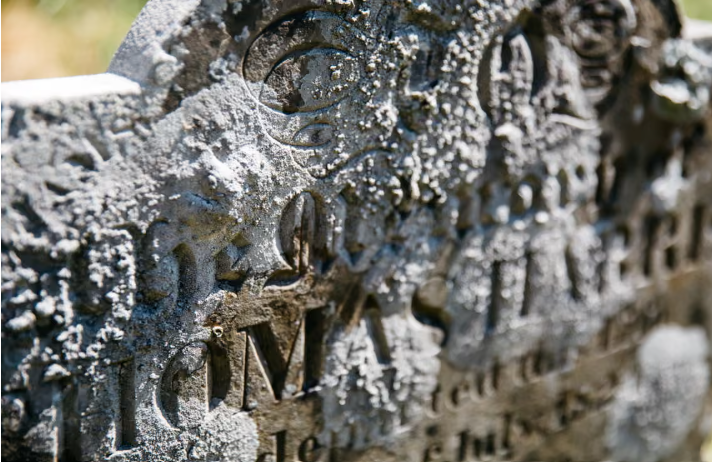
Thea agrees with Jack. Their favourite hideaway has fallen victim to the worst vandalism: carnations. Garish pink on a flat, eighteenth-century slab. Mr Icfeus, Thea and Jack call the man whose bones rest there, because those are the only letters still decipherable.
He’s in front of Mrs Moss and to the left of Mr Middle-Fissure—very posh, Mr Middle-Fissure is. Further along are Doctor Fancy Cross and Captain Headless Angel.
Thea and Jack would rather have their headstones graffitied than have lacklustre flowers left. Shows more thought. At New Year’s someone did a drive-by, tossing a cheap flower at every stone. A brown-gold daisyish thing here, a flimsy pale bud there. Nothing to signify actual remembrance.
Thea always shifts these callous offerings to the church entrance, for eroded saint heads to scowl over.
She’s heard that frowning uses more muscles than smiling, but Thea reckons that extra effort is worth it, seeing how long a frown lasts. Compare the tranquil expressions on Mary and the angels with the stern saints: a century or two will erode a smile, while it takes a good four or five hundred years to smooth over a scowl.
The saints have reason to frown; many were tortured to death. Thea tells Jack about it once he settles, cross-legged, back against Mrs Moss’s verdant stone. He pulls out his vape with a strawberry whiff, matching it to Thea’s favourite Starbursts because her foster carers would take her phone for weeks if they thought she even glanced in the direction of someone vaping.
‘Can’t believe you know this stuff,’ he says, after Thea tells him Saint Theresa’s horrific fate.
She shrugs. ‘Childhood bedtime stories.’
They still make her stomach wriggle, the hackings and disembowellings and burnings. But it isn’t an unpleasant wriggle. The stories Miss H used to tell, which Thea supplemented from a hefty book of saints she found in church, jolt her as a roller coaster ride would, or the time Evan Kirkland reached under her bra. He changed his mind before long; apparently she wasn’t worth it. She should probably be mad at him instead of wishing he’d do it again—the same way she always wanted to hear more of Miss H’s stories, and to be with Mam even though drink washed her six feet under.
In real life, Thea is not a thrill-seeker. The graveyard, with its damp, dark dead, feels far safer than the bright, blind lights of school. Here, nobody stirs. At school, she never knows what other kids might do: shout, punch her, pull her hair, mutter, pass notes. She’d like to see an old saint remain steadfast under that kind of torture.
Reaching behind her, she finds a chunk, rough and not yet worn, crumbled from Mr Middle-Fissure’s stone. She presses her thumb against it and the burning reorients her enough to breathe, if not to study. Next to her, Jack practices verb conjugations for his German speaking assessment.
‘Excuse me.’
A woman resembling a half-wilted bud has appeared beside the church. Her collar is folded over her sweater and daisies are printed on her wellies. She has pocketed hands and slumping shoulders. She’s been here before, but Thea ran from sight.
‘It’s disrespectful, you loitering here,’ the woman says.
Thea and Jack stand up. Jack brushes his hair from his eyes, and hoiks up his loose trousers.
‘We’re keeping the departed company,’ he explains.
Jack does appeasement well. When Thea’s scared, she squeaks. She scrapes the stone fragment against her wrist to help her keep her mouth shut.
The lady says, ‘People wanting to pay tribute to their loved ones will be intimidated with you lurking about.’
Who looks at teenage rejects hiding in a cemetery and thinks they’re the scary ones? As if Thea and Jack are a threat but the angry carers waiting at home and the classmates hounding them in school are harmless. Sometimes the way other people see things dims Thea’s vision, like she’s peering through grimy old chapel windows.
‘Here’s your tribute,’ she hears herself squawk and she throws the jagged stone piece, swiping the woman’s cheek. Thea grinds her heel into the rejected carnations, and this powers her flight.
III. Glasgow
A few years after the Facebook-waged hunt for the innocent bystander’s assailant, Thea will come further north to this hilltop, to our formidable assembly. After Jack’s parents confiscate his phone as leverage until he turns Thea in; after the school notifies investigators that Thea often truants lessons hiding in the bathroom; after her carers add that she doesn’t comply with their imposed schedule; after it’s revealed that she once ruined a little girl’s dress in Sunday school, and Thea serves time as a young offender, she will finally climb our summit.
Thea will find us through Jack. He’ll message Thea while she is detained and stay in touch when she’s in the halfway house later. Thea will stock supermarket shelves by day and research by night. She’ll crouch in her accommodation’s pegged-together, rough-cushioned chair with her sleeves pulled over her palms, remembering the musty chapel smell and the late-night sound of Miss H rustling pages.
Scouring Google Earth, Thea will find her old mountain home. From above, the database’s patchwork jades and emeralds will look browner and earthier there. She will recognise the mountain’s roots and as she zooms in, she will see the chapel’s caved-in steeple.
Jack will help her locate Miss H. His parents know Church of England officials who will find the name of the abandoned chapel’s former caretaker, Hepplewick, now a cathedral archivist here.
Hepplewick will have taken root in our Necropolis by then, familiar with the records of those our memorials represent and with the most intimate contours of our many graves. She will shuffle and will often need to sit, using various perches. Sitting on a ledge beneath an angel’s raised arm, she will study the gaping robe sleeves and the scythe blade dulled by rainy decades. She will stare into limestone pores and encourage lichen.
Thea will find her on a day when the city cycles through clouds like carnations or boulders, through gusting deluges and then bright-rinsed skies. Thea, still lanky yet always attempting to shrink, will cross the Bridge of Sighs. She will hang back, but Hepplewick will sense her. She will stir on her chosen ledge without looking around, understanding Thea can’t handle exposure. Thea will barely tolerate our stony gaze.
‘Come out, Thea child. There’s room on the plinth here.’
Thea will tremble out from behind an obelisk. ‘You remember me?’
‘Course. You think I was tasked with looking after many littluns over the years?’
Thea will sidle through our tight ranks. Her eyes will flit to tourists attracted by our most ornate crypts, tallest figures, and grandest views over the Cathedral. Her hand will graze each slab that leans exhausted against bigger monuments. Her slim jeans will brush past our vaults’ close-crammed corners. Thea will fidget across from Hepplewick. Her shoe will nudge clover under a Victorian gentleman’s glowering statue.
Hepplewick will keep quiet, listening to the wind. She misses the shriek of it by the mountain, and the wind’s ability to summon the lake to her chapel graves. A gust will threaten a puddle beside her on the ledge. She’ll crook her arm to shelter it.
Thea will burst. ‘How can so many gravestones be clustered like this? Does anyone remember who they were?’
‘I know who they were.’ Hepplewick will smile. ‘The records here tell more than most places do.’ She will point to the memorial figure above them. ‘This banker died of tuberculosis, and his son with him.’
Thea will sit against the plinth and nestle her fingers in a slight depression where rain has dripped for a century and a half. ‘Not as bad as those Bible characters and saints.’
Hepplewick will duck her head over her guarded oasis. ‘I didn’t reckon you listened to those. I should never’ve—’
‘I loved your stories. I mean, they scared me and all, but they made sense.’ Thea will rub the back of her scalp against the stone and hear the friction between hair and grain, a sound like her brain shivering.
Hepplewick will pull her satchel bag up into her lap.
‘I couldn’t fit anywhere else,’ Thea will confess to Hepplewick’s silence.
‘Maybe if I’d told you nicer stories, you’d have believed otherwise.’ Hepplewick will look up, shielding her eyes. ‘I didn’t like this place when I moved to the city. All the people. So unsheltered. But when the sun shines, harsh as any storm cloud, it bleaches the paler monuments like bones. So I’ve left some alone.’
‘What do you mean?’ Thea will turn fully to her old carer as Hepplewick takes a spray bottle from her satchel.
Hepplewick will inspect the stone above the small puddle. As will be her wont, she’ll leave the coal-smudged corners. She’ll find a cranny and beckon Thea with a preoccupied, hooking gesture, which Thea will recognise in a warm rush even now that arthritis swells the summoning hand.
Thea will join Miss Hepplewick as our caretaker sprays lichen flakes mixed in milk.
‘Straight from home, these,’ Hepplewick will murmur. ‘Sloughed off our old, cold chapel graves. Some finest sea-foam green.’
Thea will let Miss H grip her hand, and show her other lichen crops she’s sown on our flanks. For one day, Thea will aid Hepplewick’s mission to robe us against the summit’s exposure.
Nastasya Parker lives in Gloucestershire, UK, and works in secondary education. Her writing has appeared in Bristol Short Story Prize anthologies, Perhappened magazine, and The Phare. Her short stories have won prizes from Funny Pearls and the Gloucestershire Writers Network. She’s written a novel giving Eve’s perspective on the creation myth, and she blogs about the random stories found in daily life, at http://nastasyaparker.com/
Connect with Nastasya

Read more from Nastasya:
The Phare – ‘The Albatross of Albany High School’
Funny Pearls – ‘Pie à la Mode’
 TRASH CAT LIT