Tom Walsh
Listen to Tom read his story
My right leg starts to shrivel one winter’s day, the toes curling down and in, like the witch Dorothy dropped a house on. But no ruby slippers appear; my foot simply fades away.
Mary pops me in our truck, leans into the hairpin turns through a snowstorm on the way to University Hospital, up and over the mountains.
The doctors whisper quietly to one another, mouths shielded behind file folders, like pitchers and catchers on the mound discussing signs behind gloved hands.
They need to run tests.
When they leave, Mary scowls and says the doctors see me as a lab rat. This doesn’t surprise me given Mary’s own penchant for experimentation, though hers involves grafting new varieties of apples and crossing blackberries with raspberries.
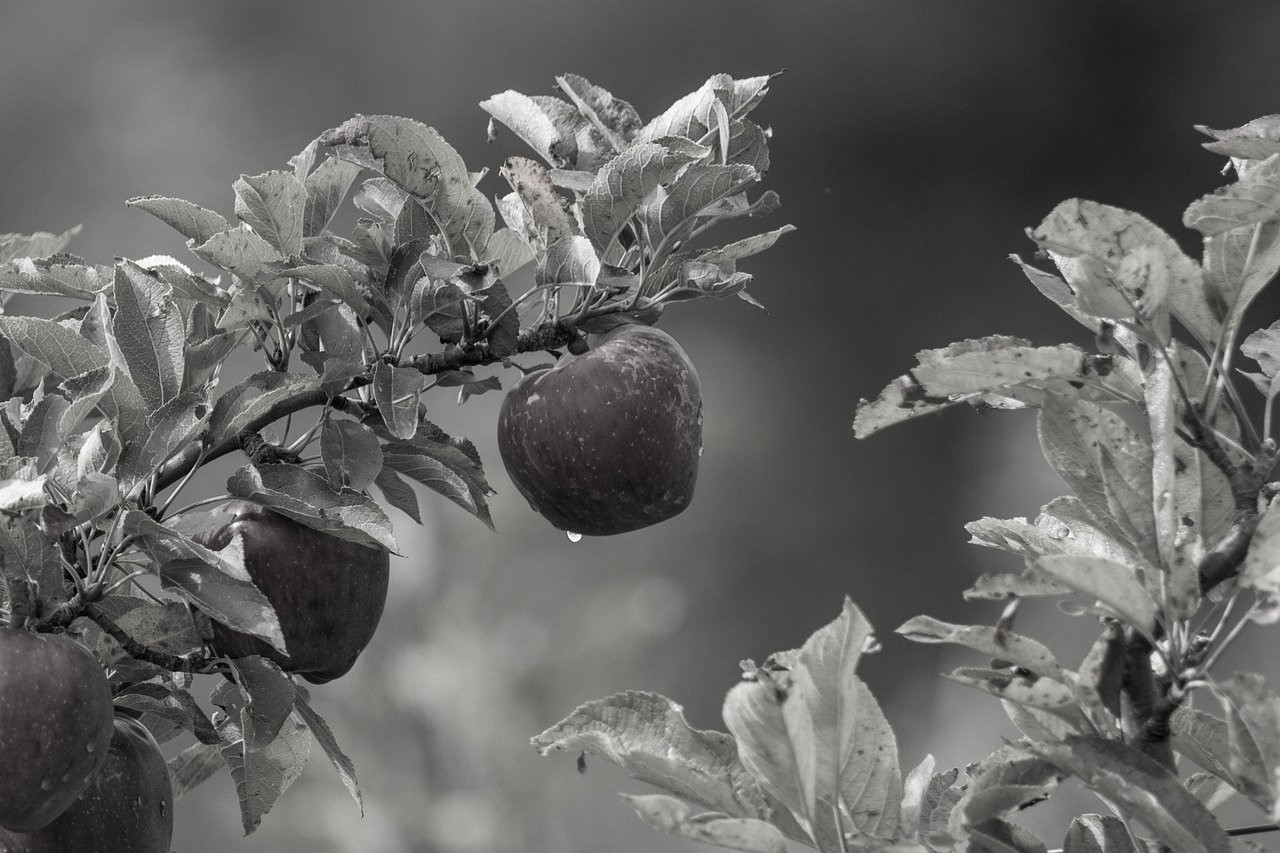
Her obsession is a Granny Smith-Gala apple cross she’s tinkered with since we bought the farm 25 years ago. The Granny Smith provides the root stock. From the Gala she cuts the scions, the branches she splices to the roots to grow apples that are crisp, tart, and sweet all in one bite, their skin emerald green with ruby red flecks. Mary calls them Granny Galas and makes pies for our friends and to sell at the farm stand.
#
It’s a teaching hospital, and my condition proves popular during rounds.
“Is it gout?” a first-year student asks, only to be roundly heckled.
“Have you been in the jungle?” asks another.
“No,” I say, “though we want to go to Costa Rica someday.”
I look out the window to the park, where Mary hunches over some early blooming Douglas irises rising through the snow. She looks around before slipping a small trowel from her bag and lifting a few bulbs for home.
Every day the doctors bring their students and poke, prod, and pepper me with the same questions:
“Have you …?”
“Did you …?”
“What about …?”
I smile and answer politely, while Mary snarls.
“I haven’t…”
“I didn’t…”
“I don’t know.”
#
By April 1, the withering spreads: The fingers on my right arm curve inward, then disappear; it’s no April fool’s trick.
The doctors swarm, and the number of students doubles. But Mary is done hearing questions that bring no answers. She finds a wheelchair and rolls me to the parking lot.
“You can’t,” says a doctor. “We need to analyze, do more tests, establish a treatment plan.”
Mary runs over his toes with the wheelchair and I chuckle all the way to the car.
In the passenger seat I belt out Thunder Road because it’s about a girl named Mary, a vision that danced across the porch of my life so long ago.
She drives with abandon; not quite reckless, but carefree, hugging mountain curves then breaking free like a rocket sling-shotting around Jupiter. I remember the bug-eyed terror of our high school drivers’ ed instructor, me laughing in the back seat, Mary flirting with me in the mirror.
We drop into our valley and its April mix of peril and promise, snow squalls and daffodils.
Away from the hospital’s white walls, I’m invigorated by the season’s work that awaits.
It’s time to transplant the broccoli and cabbage from the greenhouse to the garden, time to plant radish and lettuce seeds, to prune the fruit trees, to mend the fences, to replace storm windows with summer screens; it’s time to get an oil change for the truck, sharpen the axes, do the damn taxes, paint the greenhouse and the barn and the goat shed; it’s time to check on my brother Lou in Phoenix and see how his boy is making out at college, to check on my friend Tom from Boston to hear stories of his legal exploits, to try once again to find my long lost cousin Jim-Bob, last seen living in a shack in Montana; it’s time to get the boat ready, to tie the last fishing flies, to make sure we have reservations at Lucky Creek campground before the tourists take the best spots; it’s time to take Mary to town and have dinner at Mario’s and take a walk on Skyline Ridge and watch the sunset and surprise her with a new poem for her birthday like I do every year. It’s time to do so much, but how much time do we have?
#
“John, come to the greenhouse with me,” Mary says on my first morning home. My newly empty pajama sleeve catches in the spokes as she pushes the wheelchair over the mud.
She hands me a list. One-handed, I check the splints on last year’s tree grafts, fix a hinge on a cabinet door, replace a lightbulb. I feel productive, whole.
Mary’s blue eyes dance while she scribbles in her grafting notebooks.
It’s a good day.
#
But the nights keep nibbling me away.
On Arbor Day, strange dreams take hold. I am rooted in the Earth, the sun shining above. Birds nest in my hair; mycorrhizae tickle my toes and connect me to the forest.
I awake to find that I am Mary’s newest graft; she spliced my right hand to a small V-shaped notch she cut into her left palm.
“Be still,” Mary says. “I am the root stock; you are the scion. Sleep. Heal.”
I feed off of her strength; the night brings no more withering. Can growth be far behind?
In the coming days we stay hand-in-hand. I feel a stirring in my leg, a stretch in my arm.
“We are two halves of the apple,” Mary says, looking into my eyes as we survey the orchard.
“We always will be,” I say.
The truth? She is the star at the apple’s center; without her my half is but lonely seeds.
This piece was first published by Progenitor Magazine
Tom Walsh writes these days from Cambridge, MA. His stories can be found in Emerge, Hobart Pulp, Lost Balloon, JMWW, Bending Genres, Flash Frog, and elsewhere.
Say hi @tom1walsh.bsky.social.
Read more from Tom:
The Birdseed – ‘Diamond Nipples‘
Bending Genres – ‘When Fixing the Hole Where the Skunk Entered the Potting Shed‘
 TRASH CAT LIT