Jo Clark
Listen to Jo read her story
The pickup
Sold the RAM yesterday. Guy got a bargain. I mean. It’s perfect, not a scratch. Been valeted like a thousand times, but that smell still lingers.
The truck was the last thread tethering me. Keep wondering if there was ever anything more. I’m out of here tomorrow.
Do you remember it the way I do, or is this all in my head? It’s important for me to know. So, if you’re reading this, maybe reach out?
The highway
We took a 2-lane highway inland, towards the Hajar mountains, mirage-hazy on the horizon. Beyond, the quieter east coast, a weekend at Sandy Bay: two hours but a whole world away from the memories the city held. Took you a long time to accept it, but we’d needed this break for months.
The highway soon abandons urban motorway trappings; no straight lines, manicured verges or lighted overhead signage. Desert stretching away to either side, its colour constantly shifting, punctuated irregularly by scrubby wild sage or xerophytic euphorbia.
Sand pools in the hard shoulder. The signage, romantic in its vagueness, predates the road’s current route by decades. We pass tiny mosques, ancient falaj-irrigated date plantations, camel farms.
In the mountains – rugged, old-Testament peaks of demonic temptation, geology mostly naked of vegetation – the road alternates between steep hairpin passes and wadi valleys. Traffic is sparse, mainly ancient never-die Toyotas doing dual duty as transport and life insurance for the locals.
The desert
We both loved the desert. I was drawn by the adrenaline leap-of-faith needed to drive the RAM over dunes so steep I couldn’t see the bottom. You were bewitched by its inconstancy, the shifting character of light and landscape.
Everyone’s heard of mirages. Science says they’re caused by air temperature differences bending the light. I reckon there’s more to it; a human element. Maybe we see what we want to believe. I do know you can’t trust what you think you know. Plenty times I’ve seen a bunch of goats, substantial in the intense heat-shimmer, resolve into nothing. Tricks of the light, or the imagination. Possibly both.
Even the landscape’s unreliable; subtle winds sculpting it from one day to the next; its future shape unknowable; its past obliterated, a fickle, unrecognisable memory.
The darkness
Dusk falls suddenly here. One moment blinding, white-hot sunshine, shadows carving the landscape like scalpels. Everything dark or light; no middle ground, no grey area. Then, warm shadow-softness caressing the world beneath a velvet ceiling glimmering with distant diamonds.
On the flat stretch towards Al Dhaid, the openness of the landscape felt like a physical release of the pressure of the past months. I sensed you felt that too; you were pretty silent the whole way, but your silence there had a different quality.
I hoped you were relaxing, readying yourself to let go, consign our pain to memory, move forward. To open yourself up to life again after the loss.
The shimmering light
The light was all but drained from the sky, just the occasional shimmer in my rear-view as the western horizon continually rearranged itself with the road’s tortuous route. After a precipitous hairpin just past Masafi, heading down into a narrow valley, the RAM’s headlights picked out a figure – child-sized, unmistakeably human – under a ghaf tree at the apex of the next bend. It wasn’t a safe place to be; I heard concern tighten your throat as I slowed into the verge, cut the engine.
It didn’t acknowledge the truck’s lights, or my flip flops on the tarmac. Just stood facing away, rocking.
With no sign of vehicle or adult, I felt the responsibility for its safety fall on me as completely as the darkness blanketing the road. Heard you right behind me; you couldn’t bear the danger either, needed to save who you could.
I tapped its shoulder and felt – not the expected cotton of a hoodie, but something oily, sleek, warm. Feathers?
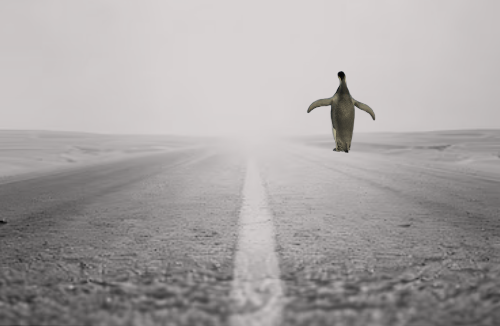
It turned its head then, showing the long sharp outline of a black beak teardropped with orange. A yellow comma marked its throat, a white apron ran from chin to feet.
The hotel
I guess there was nothing to discuss. After all, if you pick up a penguin in the mountains, you’re pretty much committed to returning it to the ocean.
It was cooperative enough, strapped into the rear seat, if you ignored the fishy smell (we couldn’t; Attenborough never mentions how penguins reek) and its gargling vocalisations. I figured it was grateful for the truck’s aircon after the 28-degree heat outside.
We parked outside our hotel-bungalow, manouevred our guest into a bathtub of cold water, adding ice from the complimentary pink champagne. Room-serviced all the fresh fish we could get. Enjoyed caring for something so vulnerable, so lost.
The check-out
There’s no standard procedure for releasing a penguin into the ocean, certainly not for the Gulf of Oman.
Just before dawn, we piled back in the truck, drove down to Khor Fakkan. Parked by the beach, waited for a gap in the traffic. Opened the door and unbuckled the seatbelt.
The penguin tumbled out. Gargling its weird noise, it waddled towards the ocean.
We walked either side of it; anyone watching us would see a small family going to play. At the water’s edge I knelt, took a selfie of us silhouetted against the mountains.
The penguin flopped on its belly, flippering into the dark waves. Disappeared. Did I catch a flash of yellow, the salute of a sharp beak further out? It was gone. Checked out. Who says you can never leave?
That was our last trip. The selfie didn’t work; a blur where a penguin should be. I can’t trust my memories, either. Where I’d thought I’d captured the return of your smile, there’s just the sadness you’d held breathless beneath your own waves. I guess not all mirages are tricks of the light.
If I didn’t know better I’d swear – I’d hope – you dove in after the penguin, flippered your way to somewhere happier.
Jo Clark likes playing with words.
Some of them have been published, including in Splonk, Voidspace, and The Propelling Pencil.
Read more from Jo
Splonk – Abstraction
The Propelling Pencil – ambulance
 TRASH CAT LIT