Isabel Yacura
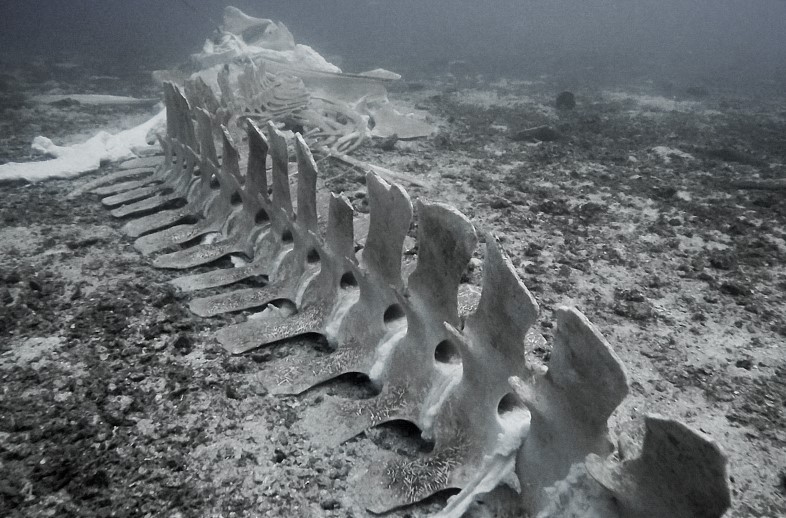
The angels clustered at the whale fall.
The team of scientists who discovered them first saw them on a 2021 expedition in the deep Northeast Pacific Ocean, just inside the Monterey Canyon. It had been an unrelated excursion, something to do with invertebrates or coral, some sort of lichen providing sustenance for – – it doesn’t matter.
Ten thousand feet below the surface, there were angels.
They thought the whale itself was pretty new. Fell maybe two or three months ago. Still some vascular tissue hanging on by tendons, half-rotted flesh in thin strips in the narrowest pinch of the great vertebrae.
How’d you know they were angels? They were asked later.
Well, they looked like them.
Whale falls are a big deal, both to scientists and the multitude of animals and organisms who stumble across them — a boon to the whole ecosystem, a jackpot for scavengers in depths where there’s little food and less light.
That was the kicker, in a way. The light. The swarms of fish and the algae growing out of the great eye sockets. The peek of white bone through the gloom.
And the angels, three or four of them, maybe, glowing at some unknown luma scale. Like angler fish, almost. The dark blue of the water surrounding them. Swallowing them at unknown intervals of distance.
A couple of months later, when they pulled one up to the surface to study, people were surprised at how big they were. Scale gets compressed in the depths, along with light and pressure and everything else. Long and thin, twenty, thirty feet, the way they stretched out — spaghettification. The phenomenon that happens near black holes.
Their eyes popping with the pressure as they got nearer to the surface. Hundreds of empty sockets in the whirling wheels that ringed their heads. The strange deflating of flesh, or something akin to flesh. The bubbling white meat of them hissing, steaming in the sunlight. Their wings strangely sodden and pathetic, spread out over the decks of aircraft carriers, an arc like arterial blood. The false feathers made of thousands of anemone-like tendrils.
That was unsettling, their corpses on the deck, but it was — fine. There’s always something a little wrong when bathypelagic creatures get pulled up to see the sun. Within the normal parameters of weirdness, at least.
The real problem was when they started to come up on their own.
Here’s the thing about pressure that all scuba divers know: you have to come up slowly, very slowly, to avoid the bends. To avoid decompression sickness, which, at its most extreme,is the sort of thing that makes your biology become physics.
About a year after they found the angels, they started to drag themselves out of the water. Finally acclimated, their slow steady climb into a kinder atmosphere, a brighter place – that sanctified spill of light. They looked different, then, when the pressure and the light were no longer strangers. And one has to ask:
How far down were they, to take all this time to come up?
Isabel Yacura is a writer and editor in Brooklyn, New York. She has been featured in Kelp Journal, Apricity Magazine, National Flash Fiction Day Anthology, and other publications. She’s currently represented by Haley Casey at CMA Literary. Website: isabelyacura.com
Connect with Isabel
 TRASH CAT LIT