Vivek Krishnan V
Listen to Vivek read his story
The key came back in an envelope with no note, which was its own kind of note. It was still on the keyring, a rubber trout about the length of a finger that Danielle bought at a gas station outside Stanley in 2019 because she said it looked like it had just heard bad news. Curtis Mabry kept the trout in the drawer with the takeout menus. He kept the spreadsheet on his laptop.
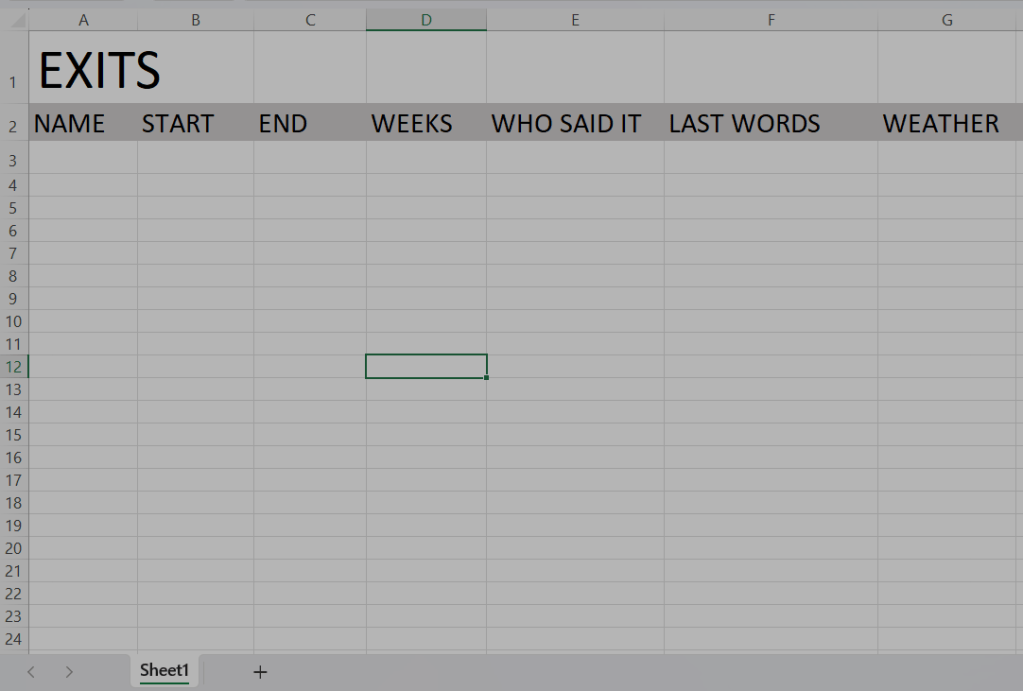
The spreadsheet was called EXITS. It had columns. Name. Start. End. Weeks. Who Said It. Last Words. Weather, which he added later, because it turned out to matter. Seven rows. Under Who Said It, all seven said her. Under Last Words, four said take care.
He was not proud of the spreadsheet. He was the assistant manager of the fishing department at the Sportsman’s Warehouse in Meridian, and he spent his days telling retired men that no, the lure was not the problem. The spreadsheet just happened, the way a junk drawer happens, one thing at a time until you have a drawer. Average duration: eleven point four weeks. Most common month: March. Most common words: “take care”, which is what you say to a man you are leaving, and also to a man with a cold.
#
The rule came at his friend Gene’s fortieth, on a patio in the North End, from Gene’s brother-in-law, a dentist named Russ who’d been married three times and talked about it like a man who once climbed a mountain.
“You know what your problem is,” Russ said. Curtis did not ask. “You never get to the door first.”
“I don’t think that’s a problem.”
“Everything is about the door,” Russ said, and went to get more ribs.
Curtis drove home thinking it was the dumbest thing he’d heard all year. By the time he parked he had a plan. He would date someone. He would like her, because he couldn’t help that. And at week nine, two weeks under his average, in daylight, in a public place, kindly, he would end it. He wrote the rules on a Post-it. Daylight. Public. Not a holiday. Don’t explain too much. He stuck it on the inside of the cabinet with the coffee filters, where nobody would ever see it, because nobody else ever made coffee in his kitchen.
#
He met Nora Bratt at 2:10 a.m. at the emergency vet on Fairview, because he was feeding his neighbor’s cat and the cat had eaten a hair tie. Nora was the tech on duty. She came out in purple scrubs with a clipboard and asked whether the cat was his.
“No,” he said. “I’m sort of guarding it.”
“Well, you’re doing great,” she said, and took the cat into the back. Forty minutes later she came out with the hair tie in a plastic bag, like evidence, and asked if he wanted it.
He did not want it. He took it anyway. He was a person who took things when they were offered.
Their first real date was pho on Vista. She ate his basil without asking. She did it while she talked, the way you’d pick lint off somebody, and he didn’t say anything because it was the most intimate thing to happen to him in two years. She was thirty-two. She was saving for a used kiln. She made bowls in a shared studio in Garden City, and most of the bowls were lopsided, and she said that was on purpose, which it was not.
The third time, she left in the middle of dinner because it was a Thursday. Every other Thursday she picked up her brother’s twin boys from hockey, because her brother worked nights at the Micron plant and her sister-in-law had gone to Oregon and not come back yet. She said yet. Curtis noticed.
“You can come,” she said. “It’s ninety minutes of eight-year-olds falling down.”
He went. He sat on a cold bench in the Idaho Ice World and watched sixteen boys fall down. Nora yelled “Skate, Jonah, skate” at a boy who was not Jonah, and when Curtis pointed it out she said, “They all need to hear it,” and laughed so hard she had to hold onto the rail.
The fifth week they argued about a rake. He bought a rake at Home Depot, used it once and found out it was the wrong rake. He wanted to return it. She said you cannot return a rake you’ve raked with.
“Why not?”
“Because it’s done raking. It’s a used rake now. You have to live with it.”
“There’s a ninety-day policy.”
“It’s not about the policy,” she said, and that was where it stayed. He didn’t return the rake. She was right, and he resented it, and the resentment was so small and so warm that he carried it around for a week like a coin.
The seventh week she was sitting on his couch with her feet in his lap and his laptop on her knees, looking for a recipe. She saw the file name. EXITS.
“What’s this,” she said.
He could have told her. He thought about it. He saw the whole thing go by, the trout, the columns, Russ and the ribs, and he saw her face reading the word Weather.
“Budget,” he said.
“You name your budget Exits?”
“It’s mostly where the money goes.”
“That’s bleak, Curtis,” she said, and closed it, and found the recipe, and her feet stayed where they were.
#
Week nine was the second Saturday in October. Daylight. Public. Not a holiday. He chose the bench on the Greenbelt below the Ann Morrison footbridge, where people ride bikes and walk dogs and nobody makes a scene. He rehearsed in the car. He had a version with three parts. The good things. The timing. The part where he said this was about him, which was the only true part.
She came down the path with two coffees, which he hadn’t asked for, and handed him one. Then he started.
He got through the good things. He got into the timing. He said something about not being in a place, which was a phrase he always hated, and which came out of him like it had been living there. He waited for her to cry or get mad or tell him he was wrong. He had a sentence ready for each.
Nora looked at the river for a while. A golden retriever went by carrying a stick that was too big for it.
“Okay,” she said.
“Okay?”
“Do you want your drill back now, or do you want me to drop it off?”
He’d lent her the drill to hang a shelf. He forgot all about the drill.
“Whenever,” he said.
“I’ll drop it off.” She stood. She was still holding her coffee. “Take care, Curtis,” she said, and walked back up the path toward the footbridge, and that was it. Four minutes. He checked. He sat on the bench with two coffees, because she’d left hers on the slats beside him, full, with the lid on.
#
At home he opened EXITS and made the eighth row. Nora. Start. End. Weeks: nine. Weather: sunny, 61. Under Who Said It he typed ‘me’. It looked wrong. It looked like a typo. He deleted it and typed it again.
Under Last Words he typed ‘take care’, and then sat there.
He was sure that leaving would feel like the opposite of being left. That was Russ’s whole idea. He ate a can of chili standing over the sink and waited for it to feel like the opposite.
The drill came back Tuesday. It was on his porch in its case, with the bits in the right slots, which was more than he’d ever managed. No note.
That week he did things he wrote down nowhere. He looked at her Instagram, where she posted a bowl. He drove past the emergency vet twice, at night, on his way to nowhere. He asked Gene’s wife, who knew one of the other techs, whether Nora seemed okay, and Gene’s wife said, “Okay how?” and looked at him in a way that made him finish his beer and go home.
On the second Thursday he drove to Idaho Ice World. He told himself he was going to the Maverik next door. He went in and sat on the cold bench where he had sat before, and he watched sixteen eight-year-olds fall down, and he did not see Nora anywhere, and then he saw that it was the wrong Thursday. It was her brother up by the glass, a big tired guy in a Micron jacket.
A woman down the bench asked him which one was his.
“None,” Curtis said. Then, because that sounded worse, “I’m sort of guarding them.”
She moved down the bench. He didn’t blame her. Somebody fell, and before he could stop himself he yelled, “Skate, Jonah,” at a boy who was not Jonah, and the boy got up, and Curtis left before anyone could ask him anything else.
#
He found her bowl in November, behind his toaster. It was green and lopsided. She’d brought it over in the sixth week with olives in it and never taken it home.
He drove it to the studio in Garden City on a Saturday morning. She was at a wheel in the back with clay up to her elbows. She saw him and finished what she was doing first, which took a long time, and he stood by the door holding the bowl like a kid holding a fish.
“You forgot this,” he said.
She wiped her hands on a towel. She took it.
“I didn’t forget it,” she said. “I left it. There’s a difference.”
“Okay.”
“You want to know if it hurt,” she said.
He didn’t say anything.
“It hurt. I liked you. I liked the cat thing.” She set the bowl on a shelf with a lot of other bowls. “I was married two years to a guy who wanted out. I argued with him the whole time. I’m not doing that again. That’s all.”
“I’m sorry,” he said. “I didn’t want to go. I wanted to be the one who said it.”
She looked at him then, a long look, the kind she’d given the rake.
“That’s worse, Curtis,” she said. “You know that’s worse.”
“I know.”
Then neither of them said anything for a while, and it was bad, and it kept being bad. A radio was on somewhere in the back. Somebody’s kiln ticked.
“Do you want to buy a bowl,” Nora said.
“What?”
“They’re twelve dollars. That shelf. I’m still saving for the kiln.”
He bought a brown one. It leaned so far to one side it looked like it was trying to hear something. She made change out of a coffee can, four ones, and she did not say take care, and she did not say anything, and she went back to the wheel.
In the car he put the bowl on the passenger seat. At the first light he braked and it slid, and he caught it, and then he did a stupid thing, he pulled the seat belt across it and clicked it in. He looked at it there, belted in, leaning.
He drove home like that, the whole way, under the speed limit.
Vivek Krishnan V is a screenwriter from North Paravur, Kerala, India. He trained in screenwriting and film direction at the Film and Television Institute of India, Pune, where his short film Without Cheese, adapted from stories by Etgar Keret, won awards. He writes for Malayalam, Tamil, Telugu and Hindi cinema. His first published story, “Avasanathe Chithram,” appeared in the Malayalam online periodical Prathibhavam in 2026. He is a member of the Screenwriters Association of India.
Connect with Vivek

Read more from Vivek:
1.
2.
