Martha Lane
Content Warning
domestic abuse
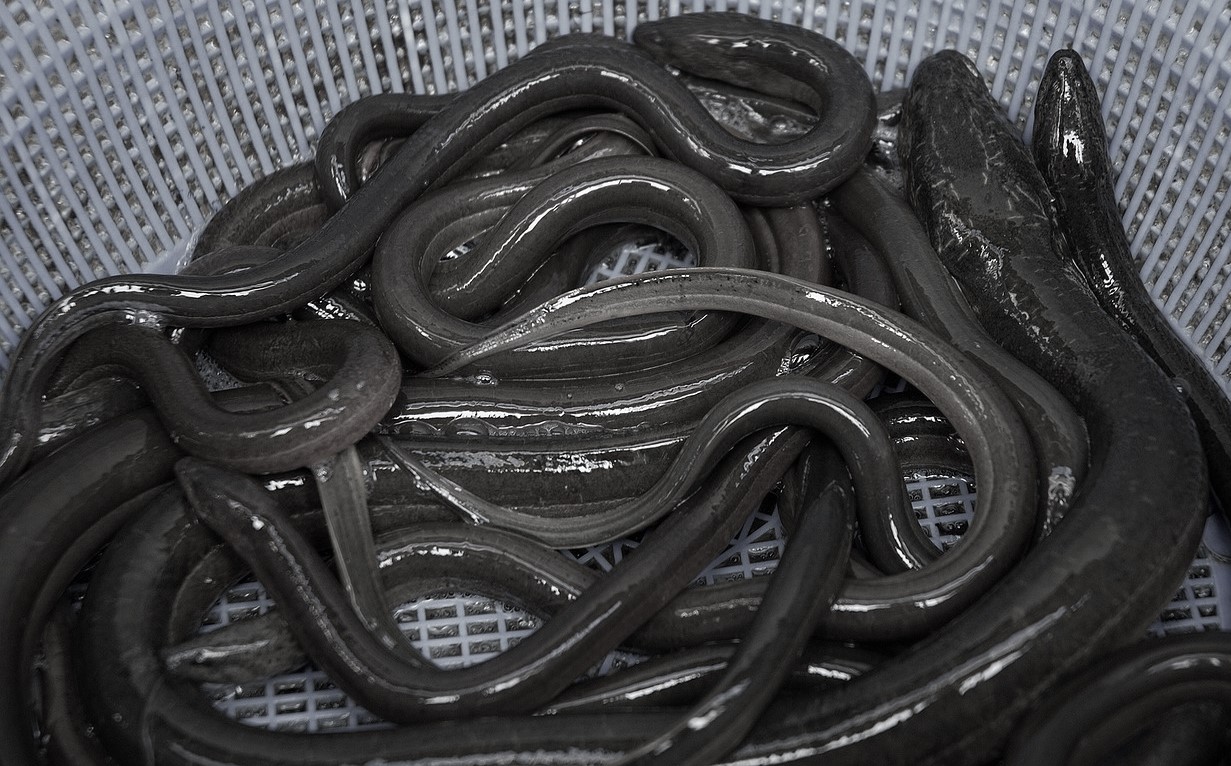
The pails dug into the daughter’s chilblained hands as they rocked with the gentle sway of a reaper’s cradle. Two wooden prisons for the eels that swarmed. Their writhing bodies knotted and coiled. The undulation of them, steeper than any hills she’d ever seen. It had been a good morning, though not in any terms other than eels. It had been a brackish beginning to the day, the salty fog heavy like velvet, crowning her hair with jewels and spicing her lips as she walked.
Her eyes itched with another sleepless night, and she yawned wide as the sky.
At least the fish had been easy to catch. The reek of entrails, the rotting flesh swiped from the butcher’s alley last night, lingered in the soupy air. The eels loved anything putrid. They didn’t care that the feel of slippery meat between her fingers made the bile in her rise and claw at her throat. No, they eagerly slithered out of their watery burrows, mouths upturned and grasping at the smell of anything off. Straight into her traps.
She was proud of her traps, supple young willow spruces woven into baskets light enough to sling over her shoulder. The gentle click-clack of them masking the gentle sucking noises of the bog beneath her feet. She stepped carefully. Eels can cross the ground if it’s wet enough. Their mouths gaping, gasping. Greedy.
It wasn’t only her bucket that writhed, the Fen was glutted now the monks had finished the cathedral and stopped exploiting the water’s bounty. Trading fish for the stone to build the colossal church had left the town starving for too long. The daughter once had sisters and brothers. It had taken years for the eels to reproduce enough to fill the marshes again. But they did, their young elvers, tiny and clear like glass, slowly swelling and darkening into adults. Into food. Into wealth.
One by one, the eel catchers, great-grandsons of the men who proudly baited the rivers of old, returned.
Then so did the daughter’s problems.
Instead of trading eels for stone, the father traded his catch at the tavern. When they’d had enough of him, they’d turn him away, back to her. He’d slink out of his yeasty burrow, filled with malice and bile. Gaping and gasping. A clumsy oaf, more fist than father. More hate than human.
The daughter once had a mother.
She reached the raised walkways that laced their way through the fenland, pretended not to notice the painful sting where blood rushed back into her fingers as she placed the buckets down. The disturbed water sloshed over the sides, hitting the wooden slats, the thud chewed and swallowed by the air’s silver mist. She pulled herself up out of the meres. She made her way as much by memory as by sight in the murky morning light. Greys awakening into green and brown with every step.
As the space between her and the water grew, her breaths became smaller. Her heartbeats more laboured. The small incline, a mountain for her stiff sodden bones. She inhaled deeply, remembered what her mother used to say. She panted it now, stronger than an ox, smarter than a fox, braver than anyone else I know.
The other catchers – men who refused to see her as such – gave her a wide berth as they began to pass, heading downwards towards their moored boats, their day only just beginning. The father wouldn’t have risen yet. And he certainly didn’t have a boat. That hull was splintered and sold as kindling long ago. The oars, shortly after. All she had to do was mine the shallows, hoicking her long skirts up and wading knee deep. Any eels plucked from there made the day less lucrative for the father, who rarely went deeper than his ankles. The reflections on the deeper water playing havoc with his sore head and bleary eyes. Two full buckets of eels would see him through a full night at the tavern. The harder she made that for him, the better for her. Sometimes one less ale was enough to keep her day from turning as sour as his breath.
She marched on until she reached the marketplace. The city folk who came to marvel at the eels, who exclaimed at the idea of eating such muddy flesh and cackled at the novelty, would be arriving soon to press their delicate silver pennies into her palms – while refusing to look her in the eye. Only coming to her when she was the last catcher standing with eels still to sell. Women and girls were burned for far less than selling eels. They were burned for less than buying eels. She could never be accused of witchcraft though; no witch would allow themselves to live such a cursed existence. But the outsiders didn’t know she was a wretch so, untrustingly, they came to her only as a last resort. This is precisely why she made sure she was the first to arrive. If she was the only choice, people had to pay, and a suspicious penny was worth the same amount as one handed over in trust.
Slowly the crowd gathered, and her eager hands collected the coins. Her buckets were nearly empty. The daughter smiled. Until the daughter caught sight of the father. He was not smiling. His only greeting was to strike her to the ground, hiss in her ear that he knew her game. The buckets spilling their contents as she fell. The eel tails slapping against the hard dry ground was the last thing she heard as she was dragged away.
The daughter woke in her bed, coddled in pain, the frantic beat of eel tails still echoing.
She tentatively lifted her arms, saw the new purple and old yellow splashes on her skin as if she were one of the cathedral’s windows. Stained. Shattered glass. She licked her dry lips and tasted the earthy metal of blood.
Outside her window she heard the snap of wood, knew it was her eel traps being smashed. Probably against the trunk of the very tree they were woven from.
The daughter thought of the sort of trap that might catch the father.
One that wouldn’t let him go.
She gingerly crossed the room and lifted the firewood stacked in the corner. Halfway down the pile, in a small cowhide pouch, was the collection of silver pennies she’d been keeping. Storing each morning’s clutch as carefully as if she were a mother bird.
But she wasn’t a mother.
She was a daughter. The daughter of an eel.
The father would not need an elaborate trap. A flagon of ale to sweeten him, and ground hemlock in the pot to ail him.
She stepped into the tavern, wrapping her shawl tight. Like on the marshes, she was the only girl here. The difference being that on the marshes the catchers only had eyes for their eels. Here, she was the fish. The stares shed her of scales, left her bare and exposed. Vulnerable. The risk she was taking pooled in her, a reservoir of dread. Her hands shook but she knew she was prepared to swim in its still depths.
She hoicked up her chin and thrust a clay jug across the wooden bar to the innkeeper. She asked loudly for the drink. Made sure her voice didn’t crack. He poured it and pushed it back, well-practiced without spilling a drop. He reached down below his bar and pulled out an empty wooden bucket, wordlessly slid that towards her too. She took it, hung it in the crook of her arm, knew it was hers left by the father in the marketplace earlier that day.
His hands had been too full of her hair, her limbs, to carry that too.
She thanked the innkeeper quietly. He nodded, almost imperceptibly. An acknowledgement of her struggles perhaps, not quite a permission for what she was going to do next but certainly an understanding.
She carried the jug between clenched fingers, the bitter foam weeping down the sides. The thought of the hemlock should have made it heavier than any pail she’d ever carried back from the river. But the thought of the slippery fish waiting for her, who would accept her gift greedily, made it light as a wisp of cloud.
She wondered how many more mornings she was prepared to wake before dawn. How many more of his catches she would have to taint. How many more cracked knuckles and blistered feet she would have to endure. How many more evenings she would wish for death when her morning’s drudgery hadn’t been enough after all.
She had proved she could provide for herself.
She had proved she was strong.
Proved she could kill an eel.
She walked through the doorway, avoiding the sharp splinters of willow wood that surrounded the father’s home – because that’s what it was now, the father’s home. There was no home for her. She placed the jug on the bare table and pulled the large bunch of hemlock from the folds of her skirt. Between two stones she crushed the leaves. The stink, fetid and rotten.
Perfect.
She paused, hand hovering over the ale. Killing eels was easy. Killing eels was necessary. They fed her, nourished her. Killing this eel would offer no nourishment. Would merely make an eel of herself.
Hemlock or not, it was only a matter of time before the father got caught in his own trap. His brewed guts and addled head would lead him to misfortune soon enough. He was not worth the danger she was putting herself in. Her life would be lost if she was discovered. Yet her life would be lost if she stayed.
With an exhale tinged with disappointment, she swept the hemlock leaves onto the floor and went to retrieve what was left of her belongings. A cowhide pouch with a handful of silver, a shawl, the wooden bucket still swinging from her arm.
She did not look back as she began to walk. Did not think of what the road ahead might have in store for her. She would walk until the marshes dried up. Until the ground began to rise. She would touch the sky.
She would never be the daughter again.
Martha Lane is a writer by the sea. She writes extensively about nature, grief and loss. Her stories have been printed widely, and her novella (about nature, grief and loss) is available on Amazon. She runs generative flash fiction workshops in an attempt to share the flash fiction love.
Irregular tweets @poor_and_clean.

Read more from Martha:
Here on Trash Cat Lit – ‘The Scavenger’
Frazzled Lit – ‘Lemon-Sweet, Lemon-Sour’
Ellipsis Zine – ‘Nesting’

 TRASH CAT LIT