June Faraday
Auntie Margret made hoarding into a curating kind of profession. I guess “curator” is a bad term for someone who chose junk so indiscriminately. She’d chide me if she heard that term – junk – but it’s hard to think of any other way to describe the piles that lined the pathways in her house.
She called herself a maximalist. But I never knew any maximalists who had pathways from room to room, leaving barely enough space to pass another person heading the opposite way.
Auntie knew where everything was. She was better than me – I couldn’t even remember where I put my keys and wallet.
All of it was secondhand, too. She’d go to charity shops and spend hours in them. Honestly, a pastime I enjoyed too; but she’d see something in the random clutter that I clearly could not. I’d tried to get her to cull her stash and be more selective. Let the things that have overstayed their welcome go. She’d gasp, just short of clutching her pearls.
“This was their first vacation with their baby,” she’d protest, pressing weathered photos to her breast pocket. Then she’d point to some lopsided mug on the table. “That was a student art project!
“And this,” she’d frown, plucking up some threadbare and balding stuffed animal on her chair. “Was someone’s baby.”
Someone’s treasures. Not hers.
#
The weather was getting bad again, so I stayed over. Auntie Margret lived alone and the family was worried the power and phones might cut out in the wind. If a tree blocked the roads, how would we reach her? I’m sure even a gust of wind could send her knick-knacks down in an avalanche and crush her.
She liked having company, but with the clutter, friends stopped dropping by and family refused to visit. But I didn’t mind, even with the clutter. I liked Auntie Margret. She was loving and needed loving back.
Her guest room was made up nice for me with a worrisome number of quilts folded at the foot of the bed. There was a path around the queen-sized frame marked by walls of cardboard boxes.
At dinner she told me all about her newest find. She did all this research – I guess that’s why I call her a curator; she knows the history of all these things. She told me all about some family in this photo album. Pages and pages of strangers going about their life. She could recite their family tree, name their pets, point out their birth dates, their anniversaries. I got a whole history lesson in the orange Bakelite and linoleum kitchen over a plate of homemade meatloaf.
During dessert, I finally dared to ask her the question.
“Why do you keep all this stuff, Auntie?”
She shot me a look over her horned-rim glasses that would’ve made me think I said the dumbest thing if I didn’t think it was the only question that anyone could ask. “Someone loved all this stuff,” she said shutting the album before returning it to its spot next to her cookbooks and a stack of old fruit crates. “Maybe they’re lookin’ for it.”
“Has anyone come to get any of it? Have you spoke to anyone in that family?”
Auntie sat back down, folding her hands in her lap over her apron.
“Well…no.”
Before I could continue, she raised a hand to shush any response. “But I think… I’d want to know that someone was still loving the things I loved. And when I research it, I really feel it. The love.” She smiled, eyes twinkling.
“It’s alive! It’s connection. Living history. Someone has to keep loving it.”
I knew my manners and knew I’d pushed my luck, so I dropped it. We watched a game show in her junky living room, then I kissed her on the head with a goodnight, and carved a path through the passages of junk back to bed.
I hardly ever looked at the things Auntie stacked up. So much information that it became little more than noise; a nothingness.
For the first time I let my eyes roam across the clocks on the wall, the cubbies of old shoes, the shelves filled with books and doodads. Even if this was Auntie’s junk, and some other sap’s treasure, there must’ve been something worth caring about somewhere in it.
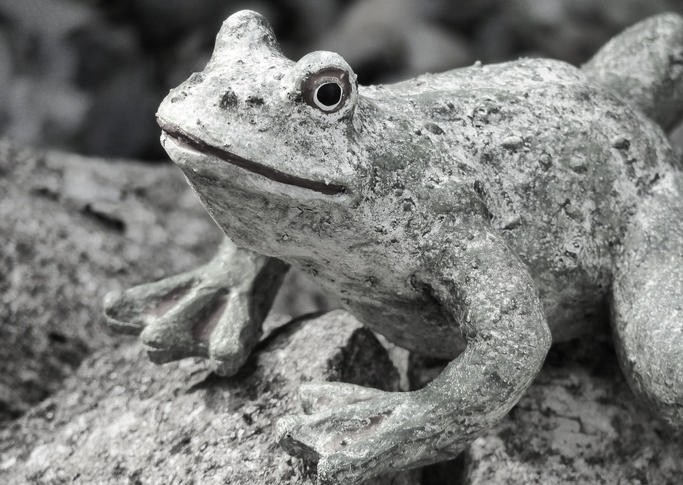
A tiny clay frog stood out to me. Jumped out, as if from his lily pad on the pond, and straight into my heart.
He had stubby little toes pressed under his chin, elbows on his knees, bottom feet dangling. His butt was smooth so he could rest on a shelf and peer out at the world. Peer out at Auntie’s hoard as if he were apart from it. The loops and whorls of someone’s thumbprint had survived the baking process, forever smushed into the bottom from trying to smooth it flat. A name and a date were carved next to it:
Jensen, ‘78.
I spun him in my hand. Let him sit on my palm. He had funny little eyes, and a smile, and all sorts of little warty textures and pretty spots. He had charm.
What did Auntie know about it, I wondered? She’d already be sleeping soundly in her cave of oddities, so I took to my phone, hoping the service out there wasn’t any worse in the storm, and tried my luck, typing,
Clay frog, Jensen, vintage.
Some old website came up. Like something out of the dial-up days. Jensen was a retired professor. He had a fondness for critters that other people found gross. His other work featured tarantulas with cute hats and gators with sweet smiles and big eyes. He hoped it would make people fonder of animals they didn’t like, give kids a love for something before the world could sour them on it. He wrote a lot on that website, until one day he just stopped posting. I read, and read, and read.
It was 2 a.m. by the time I turned the light off.
#
Wouldn’t you know it, a few weeks later I found one of his figurines at the antique shop on the corner. A cross-legged lizard, holding her tail in her lap.
I bought it, figured,
What’s one more little thing when someone loves it? That’s what makes it treasure.
June Faraday, besides being a writer, is a lover of ephemera and enjoyer of the mundane. She takes much delight in fantasy, science fiction, speculative, and any other sort of story that strikes her fancy. June aims to share and read stories that shine a light into the odd things we take for granted as well as the magic of day-to-day life.
Read more from June:
Frazzled Lit – ‘Waking Hours‘
 TRASH CAT LIT