Mairead Fagan
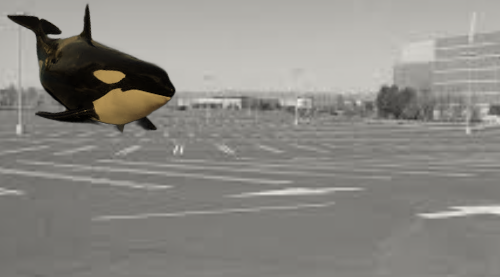
When the orcas first learned how to swim up out of the ocean, we thought it a wonder. Any sign of precipitation and they’d scud from the spuming waves, sea-suck gurgling behind them, to form vast monochrome murmurations. ‘What a marvel,’ we said, as we gazed, eyes rain-blind, ears tuned to that click-whistle calling, their cetacean song. ‘Miraculous,’ everyone agreed.
We’d soon understand.
Going outside when it’s wet is now ‘highly inadvisable,’ the government leaflet says, but it’s been weeks and I’m down to a cup of lentils and some oatmeal and Olive’s been grizzling. I see old Joe from Habitation Block 6 out on the street, twitch-eyed and armed to the gills with those mail order tridents you can buy, but they’re just pop guns, really; the modern-day equivalent of firing a blunderbuss against an army of marauding invaders.
Orcas hunt in packs.
It used to be safe in a car until the orcas observed how crows scoop up snails and drop them from a height to fracture the shells, so now your best bet is keeping to narrow streets or close to buildings. The orcas struggle to swim alongside walls. I put on my concrete-coloured pac-a-mac – camouflage is helpful – then strap Olive into her pushchair and pull on the thick plastic rain-shield. She looks wavy and underwater.
I poke my head outside.
Low cloud. Orcas often lurk inside its dense fog, occasional blunt heads emerging to peer around with large, calculating eyes. The trick is to look for darkness floating through grey; they haven’t yet learned to dissolve. It looks clear though, and the first stretch is easy. My right shoulder grazes pre-fabs and I sprint over crossings. The rain’s bullet hard, strafing the streets; the drains aren’t coping – fountains spout from blow-holes to form rivulous brooks. My shoes are soaked, but we’re almost there. Olive claps her hands.
The food-mart.
It’s enclosed within a thick-walled glass dome. Sometimes, whale pods hover outside, flippers twisting like kestrels’ wings. They buffet the glass so hard that stacked cans tumble and cereal boxes shiver on shelves, but so far it has held; a team checks for cracks around the clock. Artillery is stationed at the entrance, a giant harpoon aims skyward, ready to launch.
It’s crossing the wide, empty car park that’s dangerous.
The crew lounge in their shelter, vaping and scrolling through phones. I’m ankle deep in water, choosing my moment. I look up, scanning for shadows; the rain batters my face and slews my vision; the food-mart is tantalisingly close.
I take a deep breath and start to run.
The pod must have been swimming high. There are five of them, but it’s the smallest, a calf, which breaks cloud first, white belly skimming, its fluke like a flat-winged moth rippling mist behind. The klaxon sounds, and I hear the whirring of hydraulics as Olive yells, ‘Run, Mama, run,’ and we’re seconds away when I hit a pothole, and the pushchair flips out of my grasp into the calf’s open maw. I scream as the released harpoon slices the drenched air to thunk into its flank. The calf falls, splashing onto the tarmac, flesh swaying, as the rest of the pod arc up and away, back into the cloud bank.
A direct hit.
I’m on my knees, still screaming, but the crew are right there, shouting and yelling directions. They pull the mangled pushchair from the jaw and there’s a silence broken only by the drumming of rain and the hoarse shuddering of the whale.
‘Mama?’ I hear.
The metal frame of the pushchair is crushed, and I frantically check her all over, but she’s barely bruised. I squeeze her close as whale blood seeps in a slow mingle with the surface water.
The calf stills.
Inside the mart, I cash in my ration coupons and stack my trolley with canned whale meat, tallow for candles, oil for soap, then wait in the refuge area where the TV screens are showing coastal footage; the rains are slowing to a thin mizzle and the orcas are returning to the ocean, a sure sign that dry weather is on its way.
We’ll be safe, for a while.
I hold Olive in my arms, sinking my face into her damp curls, while she stares with wet, seal pup eyes at the abattoir crew dismembering the corpse. The larger orcas have left, but through the fading cloud, we see the mother, still circling, splintering the sky with her mournful, sonar cry.
Mairead Fagan writes and teaches in the South West, UK. She loves to read, to write, to walk, and she has recently developed a love of herbal tea.
She won BFFA in February 24, has been published in a range of wonderful literary magazines, and her stories have been nominated for Best Small Fictions and Pushcart.
Read more from Mairead:
Here on Trash Cat Lit – ‘Cockling’
 TRASH CAT LIT