Ali McLafferty
Listen to Ali read her story
I’ve heard countless theories about MINA. No one, not even the FBI agents I partnered with, had come close to the truth. That’s the price I demanded for the revolution I created: absolute secrecy.
Most theories begin with my wife. This is the seed of truth from which the lies sprout.
We called ourselves the Wood Whisperers: I spoke to the trees, she to the soil. I was studying the cries of pain trees let out when attacked. Every time an aphid pierces a leaf or a human saws off a limb, trees release chemicals that float through the forest like silent screams.
This is why my wife never let me mow the lawn: she said it smelled like blood.
Her research was underground, on the mycelium network. I learned about it on our first date, when she sketched it on the back of a napkin still imprinted with her lipstick. She called it the “wood-wide web,” where plants whisper instructions, cry out for help, share resources and tend their nurselings.
My wife spoke with her hands: they fluttered and swooped like birds with every word. She laughed with her whole body, so hard it made her hiccup. She always had dirt under her nails and twigs in her hair; I used to shake out our sheets before bed because she shed like an autumn tree. She used to joke that we’d name our kids the way we labeled our lab work: Rhizobium, Morchella, Quercus.
I fell in love with my wife in the woods, cradled in the arms of oak and maple, lying on beds of loam.
And that is also where I lost her.
#
Hope is a form of insanity. When you lose someone to death, your heart breaks cleanly: you spend the rest of your life growing around the ragged edges, like a knot in a tree trunk. But when they are stolen from you—when there’s a possibility they’re still alive, hidden somewhere and screaming for you—the agony is ceaseless, the wound impossible to close. It’s like being burned alive.
I never slept. That would mean leaving her out there alone, missing the moment I might find her. The forest swarmed with police, dogs, and drones, and at night it blazed like a small city. I screamed her name so long I started swallowing blood, and tore off my fingernails clawing the ground. I couldn’t tell dream from reality: eyeballs bulged in the knots of trees and ears blossomed from the ground.
This was when they spoke to me.
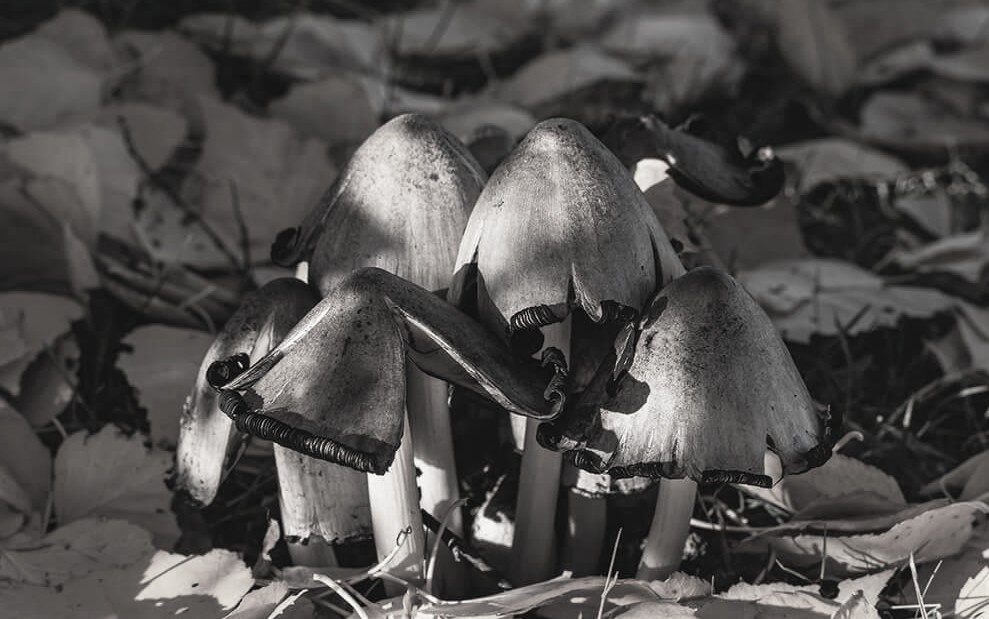
I’d collapsed in a birch grove, my face pressed into the soil; the scent was like her hair. Under my lips I tasted something slick and sour, and raised my head to see a patch of inky-cap mushrooms.
I stared at their long, white stalks, their bell-shaped caps dripping tar-like sludge. Gently, I worked my fingers into the soil around them: it was damp and crumbly.
But we were in a months-long drought. The forest had been parched so long the ground had hardened and cracked. Nothing should have been growing there.
Not unless something was feeding it.
I bellowed with all my might, my ruined voice collapsing—but the dogs heard.
The police thought I was delirious, pounding on the ground like it was a door. But when they lifted that narrow box, opened it to see the creature that was once my wife lying inside . . .
That was the birth of MINA.
#
She did not survive. Not really. Only enough of her brain to keep her breathing.
The university gave me everything I needed to keep her comfortable at home. I fed her through a tube, brushed her teeth and bathed her, read to her at night as she stared at the ceiling, one eye still and the other wandering.
She was beside me when I built the Mycelium Information Network Agency. You see, the fungal matrix is a brain: a huge web of hyphae branching through plants and soil, sending information along electrical and chemical signals. And by then I knew it was constantly speaking—we just hadn’t learned to listen.
MINA translates floods of information through a mesh of filaments that fuses with the hyphae: where the ground was disturbed, where blood or urine entered the soil, where DNA signatures were found. I’ve tuned it so finely it can tell me what a victim ate for breakfast, what brand of cigarette the attacker smoked, what soap clung to their hands.
The man who stole my wife was hooked up to a different set of electrodes just last year, strapped to a chair alone in a room. The police let me watch; I described it to my wife while I brushed her hair.
Our house is filled with letters of gratitude from families and police departments; they paper our walls. So many have tried and failed to replicate MINA, but they always run into the same problem: they try to create a computer. But you see, the mycelium network depends on biochemical feedback; it won’t speak with a machine.
It requires something that evolved to contain vast amounts of information, to process it into thought and translate it into speech. And if this cognitive center is effectively empty, with only minimal synaptic activity . . .
I call her the Wood Whisperer. She is the secret that has changed the world.
They would have taken her away, you know. Called me a monster. But every time I see her lips move, hear her voice again . . .
Hope is a form of insanity.
For years she lingered just beyond my reach, half in this world, half beyond it, like the faint presence I once felt beneath the earth.
Then she began to fade. Her words slowed, her breath ran shallow. I started to feel faint touches, like the pull of invisible fingers.
I let her go this morning. Now that I find myself facing the darkness, I want to find her there.
Bury us together, in the woods. Me, and my Wilhemina.
Ali McLafferty earned her PhD in History at UC Berkeley. Her fiction blends the historical with the fantastical, and appears in F(r)iction, The Forge, Mslexia, Fractured Lit, Flash Frog, Gone Lawn, Small Wonders, the Good Life Review, and elsewhere. She is also a visual artist whose work has appeared in Centaur, Foofaraw, and Flash Frog. Both her visual artwork and fiction have been nominated for Best of the Net and Best Small Fictions.
Connect with Ali
Read more from Ali:
1.
2.
