Kathryn Kulpa
Listen to Kathryn read her story
Desert sun can leach color out of wood, same as it does out of anything that grows: scrub grass, sage, bent stands of creosote bush. Dust-dimmed, like the lean jackrabbit that zigzags through the hills, like the fox with a twisted face that pauses to lick a paw. Even his red is tamped down. They called it the green house, but was it ever green? I see it now and it’s faded grey, the rented cottage where my grandparents lived when my grandfather worked on a film crew in the 1950s. They said the government men made everyone leave in the clothes they had on. Couldn’t pack. Couldn’t take anything with them.
I pictured the prop crew, the lighting techs, the electricians (my grandfather) driving away. Did they look back? See their cottages faintly glowing, like fireflies on a summer night? Did they know then what was in the dust that blew all around them, dust that coated their car windshields, that settled on kitchen tables, on typewriter keys, weaseled its way into closed drawers, shoe boxes, garment bags? Even hair, no matter how often she washed it (my grandmother). And in all the invisible places: teeth, bone. In the DNA of a child waiting to be born (my mother).
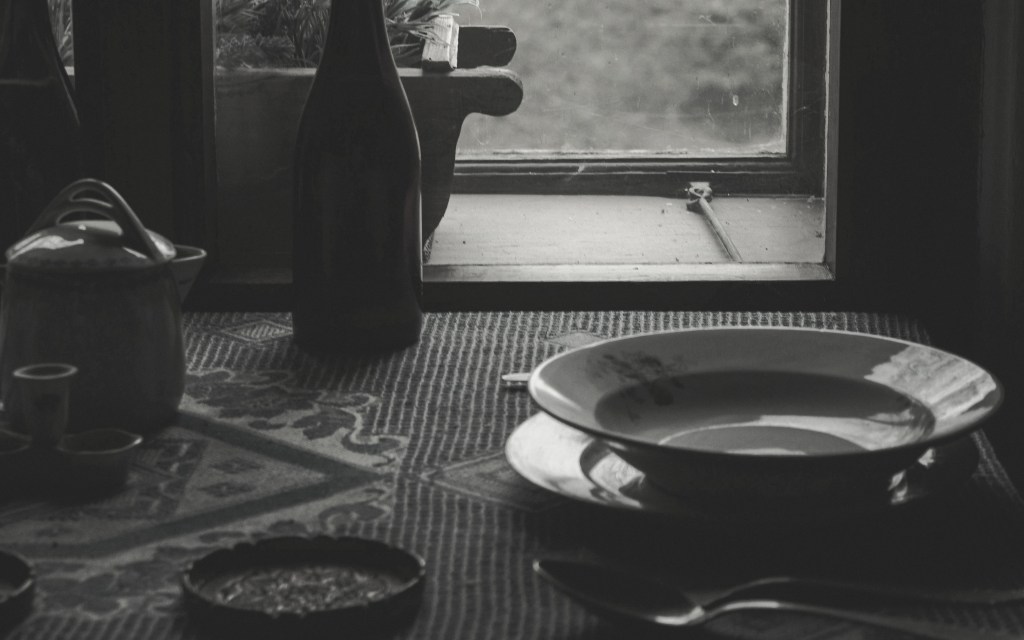
They said people left with dinner on the table. If you went back there today, my mother told me, you’d find the tables still set. Char-broiled steak, baked potatoes snowcapped with sour cream, little hills of peas, now black and dessicated, still sitting on plates, waiting to be eaten. Candlesticks engulfed in melted wax. The last supper.
She only had one picture of her parents in that house, a few more from the film set. But my mother always talked about wanting to go back, to see it. Even at the end she kept saying: when I’m better we’ll go. We’ll find that house.
The image of that waiting table, a Miss Havisham-like ghost feast, haunted me all my life. But I’m here, at last, and the table is empty. Faded red-checked tablecloth, a half-unfolded road map, a pair of sunglasses, the old kind that clipped onto regular glasses. One glove, leather reinforcing the fingers, the palm. Driving gloves. People wore gloves then, to drive. And hats, everywhere.
They went to a hotel in Reno first, my mother said. They had to stay for testing. The film company offered to fly everyone back, but my grandparents wanted to drive. They loved the desert, my mother said.
The actors died first, or maybe those were just the first deaths people heard about. Maybe there were hundreds, thousands of deaths before theirs: dung beetle, grasshopper, vole, rabbit, fox, crow, vulture.
Sand sown with teeth. Cactus needles lodging in hearts, lungs, brains. A field of bloodred poppies, burning the desert nights to ash.
They talked about the desert, but they never went back, my mother said. They left and took nothing with them but the one thing they carried, lodged deep in their blood and bone. In my mother’s, later.
In the dusty, almost-orange desert light I squint and see them sitting at that dinner table. My grandmother in her flowered hat, my grandfather with his horn-rimmed glasses, my mother, younger than I’ve ever seen her except in pictures. They’re leaning in toward each other, eating, talking, laughing. The candles blaze.
Wind slams the door shut. A ribbon of yellow tape rustles. Three black triangles, stacked in a circle. I wonder what waits in my bones. When I’ll join them at that table.
Kathryn Kulpa has work in Boudin, Claudine, Matchbook, Okay Donkey, and Trash Cat Lit. Her stories have been chosen for Best Microfiction, Best Small Fictions, and the Wigleaf longlist. She believes in the beauty of flawed objects, the necessity of kindness, and the wisdom of the cat distribution system. Find her at kathrynkulpa.com
Connect with Kathryn