Sophia Adamowicz
I
The bell in the housekeeper’s bedroom rings for the first time in 119 years. Its jingling – quiet as black ice at first, but getting louder – strikes Eleanor Turbot with a half-forgotten dread. Lifting her face from the washbasin, she watches in the mirror as the bell bounces on its wall mount. Labyrinths of web tremble, no longer able to contain the bad tidings. The ringing grows sharp enough to spur Eleanor into her smock, kirtle, stockings and shoes, to fasten her belt of keys, including the ones to the private side of the house – and obey the summons.
Of all the days to call! Master couldn’t have known that his Waking would coincide with the first day of Burleigh Hall’s annual Tudor fair, unless the screech of the peregrine falcon penetrated his Sleep and stirred memories of chasing spindle-legged deer through the mists of early morning. Eleanor had felt it, too – that pull of her birth era. She shouldn’t have been surprised that a renaissance of the Renaissance would rouse him. Still, she’d indulged in fantasies of a day on the grounds of the hall without worries, the beat of the tabour pulsing in her body as she laughed at the ineptitude of twenty-first-century jousters.
Now, she hurries downstairs, to the hallway that’s already buzzing with women wearing cheap imitations of her clothes, and unlocks the door marked ‘Private.’ Strength drains from her legs as she climbs the stone steps. She never can predict what demands her master will make, even after all this time.
Before she has a chance to knock on his chamber door, she hears 119 years’ worth of phlegm being cleared from a throat, and then a gnarled, “Come.”
Eleanor breathes a lungful of air and steps into the stale darkness.
II
Outside, sunbeams slice the sky. Eleanor tells herself it’s the intensity of the daylight that causes her eyes to weep, and not the job she has to do. When Master’s eyes met hers this time, they were a glowing, poisonous green; his teeth dripped saliva. When he made his request, she answered, “One so young? Again?” A moment of silence gave Eleanor hope that he may be reconsidering. But the yes that followed raked its claws across her brain.
She wipes the corner of her eye and scans the crowd for someone whose fresh blood will zing on the Master’s tongue. The Tudor fair is not specifically for children, but there are a few younger girls at the craft stall, admiring the jewellery. They look to be the same age her Annie and Isabel reached, before they passed. The parents are nowhere to be seen. They might be enjoying a beer, oblivious to the war waging in Eleanor’s heart.
“Nice costume,” someone says.
A young man, crouching among the birds of prey, smiles at Eleanor. He’s no more than a boy, one of the few staff members in modern dress.
“Thank you,” Eleanor says. “I made it with my own hands.”
“You’re kidding! That must’ve taken you ages.”
“Time is the one thing I have in abundance.”
“Same,” says the boy. He makes a kissing sound at an Eagle-owl, which hops off its perch and guzzles down a dead rodent by his trainers. “Time, and voles.”
Eleanor laughs. There’s something different about this boy. The air around him ripples with a cool energy that makes the hair on her arms stand on end.
All at once, she knows what to do. She’ll have to live the rest of her long life with the guilt, but it’s the only way.
“Have you seen the taxidermy collection in the house?” she asks.
“Taxidermy? You mean stuffed things?”
“Stuffed is one way to put it. I like to think they’re frozen in time. We’ve got predatory birds aplenty, if it’s owls that take your interest.”
The boy squints at Burleigh Hall, its red-brick gables and chimneys splendid in the sun, and shrugs. “I suppose I could do with a break.”
He wipes his hands on his jeans and stands. “Be good!” he tells the Eagle-owl, who gives him a goodbye screech.
The boy sticks close to Eleanor, seemingly more wary of the crowd gathered around the stall selling candied nuts than the stabbing beaks of birds. Eleanor repeats to herself that she’s doing the right thing. One life lost will save many more.
III
The falcon’s talons are moments away from clasping the swallow. Its body is an arrowhead, wings arched back in two deadly Vs. The eyes give away none of its bloodlust. Like the rest of the bird, they’re motionless inside the case of glass.
“Cool,” breathes the boy. “You’d think someone had blasted it with a freeze ray.”
“Freeze ray?”
He points at her with two fingers. “Pow!”
“Oh,” Eleanor says, none the wiser.
She walks over to the next display case. It holds a barn owl spreading its wings in flight like a great and terrible angel.
Eleanor lowers her voice. “We found this one trapped in an outbuilding. She never intended to stay here for so long.”
But the boy has lost interest. He is already heading towards the door that leads to the armoury.
“If you like,” she calls, “I can show you an even better collection. Rare treasures from across the centuries.”
He turns, pushing a floppy fringe out of his eyes. “I’d better be going.”
“You’re in no rush, surely.” She approaches him and slides her arm through the crook of his elbow. A shudder at the unnatural closeness comes over her. “There’s so much to see. Master is quite the collector.”
Curiosity lights the boy’s face. “The Master of Burleigh Hall? I heard he comes from a whole line of recluses. Is that true?”
“After a fashion,” Eleanor says, leading him towards the private quarters. “He dislikes the noise of the outside world. Even so, he does receive visitors from time to time.”
The boy willingly ventures up the staircase towards her master’s chamber. He says, “There are so many stories about this place. Do you know someone actually died at the Tudor fair a few years ago? I’m amazed they still run it.”
“Yes, well,” Eleanor murmurs, “it’s unfortunate, but life must carry on. Here we are.”
They stop. The silence of something large holding its breath lurks at the other side of the chamber door. Eleanor hesitates before knocking. The boy’s eyes are the innocent blue of a jay’s wing. They make her doubt everything she’s ever known. And yet, there’s no going back now.
IV
The latch clicks and, with a sound like a rasping inhalation, the door swings inwards. From the hallway, light creeps in and uncovers the grainy shapes of boxes stacked floor to ceiling. Eleanor crosses the threshold, shuddering as the cold of the chamber sinks into her skin. She walks over to the boxes as if nothing is amiss, aiming for a smaller stack in the corner where black mould climbs the wallpaper, directing the boy’s attention away from the curtained four-poster bed. She opens the box marked ‘Waking of 1867’ and takes out a leather-covered case.
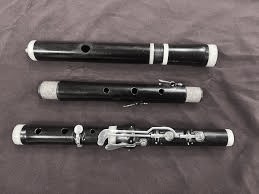
“Here’s a very fine item: a late nineteenth-century flute with an ivory barrel embouchure.”
She’d play upon it to reel the boy in further, if she wasn’t so reluctant to touch her lips to the mouthpiece. The last person to breathe into that flute, a beautiful woman of twenty summers, died with it still in her hands, her body jiggling like a puppet while Master fed.
The boy hovers on the threshold, saying nothing.
Her chest tight, Eleanor rummages around in the box for a more tempting item, casting a side-long glance at the bed. It may just be a trick of the low light, but she detects the flicker of a drawn curtain.
At last, the boy steps into the room. He joins her, kneeling, on the floor.
“When did you know?” he says, so quietly she has to strain to hear.
Pity flows from her heart. “Almost as soon as I saw you.”
Eleanor knew the signs after so many centuries: the disturbance of the air, the cold, the comradery with nocturnal creatures whose hearing is attuned to the world of spirits.
“The one who… at the Tudor fair a few years ago?” she whispers. Eleanor hadn’t been there to see the death happen, though she heard afterwards how the dancing troupe, ignorant of the tragedy taking place behind them, had continued with their gavotte as the boy gasped for his life.
His chin drops to his chest. “Nut allergy. Didn’t have my Epipen. Stupid, really.”
There’s a movement in the corner of Eleanor’s eye. She doesn’t have much time. “You must do this one thing for me. I promise, it’ll be worth it.”
The boy’s head lifts. “What?”
A skeletal hand, tipped with long nails, draws back the bed curtain.
“He only eats fresh food.” Eleanor stands and takes a few steps back towards the mould-ridden wall, to get out of the way. “Anything else would be poison to him.”
The boy scrambles to his feet and looks from Eleanor to the darkness inside the four-poster. “Who?”
Master springs from the bed, an arrowhead of bone and hunger.
V
At midday, the crowds gather in the middle of a field to watch the jousting tournament. Eleanor waits by the birds of prey until the area around the food and craft stalls empties out, and when the market-day hubbub has faded into the ease of a Sunday afternoon, the boy comes back. He appears without ceremony by the Eagle-owl, as though nothing happened in the intervening time.
“I’m so sorry,” Eleanor says. “It had to be done. I couldn’t let him take another young life.”
Shame cuts through her, not for killing the man she’s served for centuries, but for refusing to bear witness. She turned away when Master latched on to the spectre’s neck; she ran from the house when he began coughing up black sludge. How frightened the boy must have been, left on his own. Now, though, he puts out a hand and the owl hops towards it, then dips to let him stroke its feathers.
“What’ll happen to him?” The boy’s voice is quieter, stonier than before.
“He will sicken.”
“His eyes,” the boy whispered, “they bled. His mouth was frothing, like a rabid dog, but the froth was black. He tore at his own tongue.”
“Did he—?”
Her words are cut off by the sound of screaming from the next field. The dread that has been mounting in her chest all morning drops to the base of her belly.
“Did he follow you?” Eleanor demands.
She doesn’t wait for the boy to close his gawping mouth, but lifts her skirts and runs to the makeshift arena, where baffled speculation (It’s part of the entertainment, right? Cosplay?) and panicked cries (It’s real! Jesus, it’s real!) rise into the summer air from the audience. On the side of the tilt rail nearest the viewing platform, a small crowd of people in forest green shirts and trousers has gathered around a heap on the ground. A jouster, wearing a cape of crinkly silver, walks in circles, gabbling, “Just ran out. Crazy. Delirious. Just ran out.”
A man in a bright yellow jacket stands in front of Eleanor, saying, “Stay back, please, Madam,” but she pushes past him to get a final view of her master in his dust-caked doublet and hose. The pointed teeth that ruled both of their lives for so long are lost in the smashed eggshell of his skull.
“What will you do now?” The boy is beside her again.
Eleanor lifts her gaze towards the edge of the field. She has never thought beyond this moment, in all her hours of dreaming. The answer tastes of rosewater and cinnamon.
“I will be mistress of myself.”
Sophia Adamowicz (she/they) is a writer and tutor based in Suffolk, UK. Her work, both fiction and nonfiction, has appeared in several publications including Cunning Folk, Crow & Cross Keys, Haven Speculative and Trash Cat Lit. As the co-founder of Artemis Writers, Sophia runs creative workshops in communities around Cambridgeshire. In her spare time, she sets herself increasingly ambitious running goals and fusses over her beloved cats and Bernese Mountain Dog. Bluesky: @sophia-adamowicz.bsky.social // Insta: @sophia_adamowicz // X: @SophiaA_writes

Read more from Sophia:
On Trash Cat Lit – ‘Closing Time at Mr Marvell’s Museum of Curiosities‘ and ‘Wixton Fen‘
Cunning Folk – ‘The Magician‘
Crow and Cross Keys – ‘The Frithyard‘
 TRASH CAT LIT