Courtney Welu
Listen to Courtney read her story
Content Warning
death of a child
Somewhere in the country once known as America, Rolfo started collecting dreamcatchers.
We’d already been on Earth for several months at that point, gathering data and scientific readings, taking biological samples from the bodies, still and rotting in their beds. We were a team of five scientists; Rolfo was the cultural anthropologist, and therefore the one that I had deemed least useful. He was much more interested in the way that humans lived than the way humans died, although the dying was the primary concern of our mission. Millions of humans on Earth dead within three days and no readily available explanation. Warfare? Genocide? A tragic cosmic accident?
It wasn’t that Rolfo didn’t care about the dying; he undoubtedly cared more than the rest of us. He examined the bodies with clinical distance, testing their blood and saliva and inspecting their fingernails, while Rolfo wandered about their homes, trailing a hand across the objects left behind, waiting for one to call out to him, speak to something about human existence that we didn’t understand.
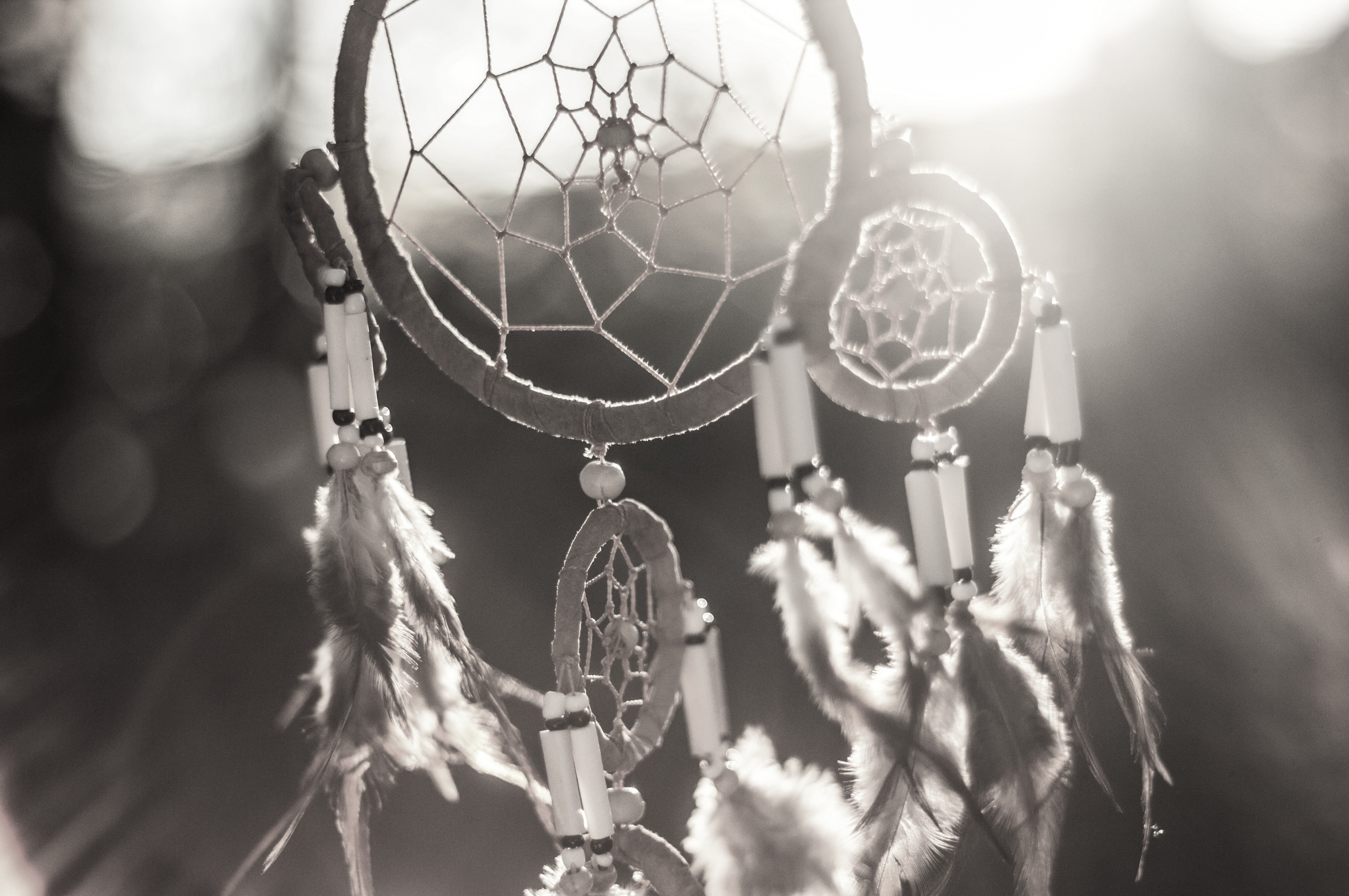
I wasn’t sure how sense-memory worked, for Sinits, if they could literally hear these fragments speak. All I knew was that Rolfo once disappeared into a little girl’s bedroom – she was dead in the windowsill and he’d closed her blank, unmoving eyes – and he returned with a small token, a circle with a webbed center, feathers fluttering down, fragile, pastel pink and green.
“It’s incredible.” Rolfo showed each of us in turn, reverence in his careful grip. “I can see the girl’s dreams –haunting echoes, sharp fears, quiet dread. I can see her parents and grandparents, her brothers. It holds so much more than anything I’ve ever touched. And for a child! Limited memories, but such vibrant dreams.”
“What’s the point of that?” I asked him, not bothering to look up from the radiation meter I had set up in the kitchen. “Dreams are just imagination. What can a girl’s fantasies tell you about humans?”
“Every species in the universe dreams,” Rolfo said, unbothered by my disdain. “It’s the one thing we all share.Other than death.”
I thought about that for a long time. Meanwhile, Rolfo investigated our limited Earth history books, found the symbol called a dreamcatcher. He learned it was a kind of protective talisman, but also a simple aesthetic decoration for many. We didn’t find the dreamcatchers often, in our travels that took a better part of a rotation of the Earth around the sun. Usually in the bedrooms of children, though sometimes we found houses littered with them and other heavily prized objects according to Rolfo’s research and collection of Earth memorabilia. Objects of spiritual experience, of worlds outside of the cold, hard data that I spent my days poring over. I didn’t understand why he cared so much about things that were so cerebral when the bodies sat in front of us, grotesque in their untimely ends.
After our year of field work expired, we returned to the ship just above Earth’s atmosphere. It would take months to return to our sector of the galaxy, and we weren’t close to any answers about the mass extinction event that wiped out an entire planet’s population.Still, we had reams of data to process once we arrived at home. An answer could still be found.
Rolfo was the only one of us who considered the mission an unqualified success, but then he was also the only one of us with a sense-memory of human history. The only one who experienced anything beyond death and decay, who saw humans alive and vibrant in the objects they’d left behind. And still, with all he’d sensed, his most prized possessions were the dreamcatchers.
I stopped in his cabin shortly after we’d departed Earth’s solar system. Most of the objects he’d taken had been sealed in biohazard bags to be examined by other Sinits to see if they could construct anything more concrete from the sense-memories. But the dreamcatchers were all with Rolfo, hanging on his walls, from the ceiling, some floating in mid-air depending on how the gravity balanced in the room. Rainbows of colors, feathers from birds that I couldn’t begin to identify. I found it baffling, yet there was a part of it that staggered me as well: the care that Rolfo took with these useless tokens.
Rolfo sat in the center of the room, tenderly holding a dreamcatcher of pure white, the webbed design in the center not a circle or a flower, but a star.
“When she laid down, head pounding, she was so scared,” Rolfo whispered. I didn’t know if he was talking to me or to himself. “Her parents were dead already. She hadn’t been able to wake them. She held the catcher as she slept, for good luck, to take away bad dreams. She died in that sleep.”
“Did it hurt?” I asked him, half because it was my job to know, and half out of unexpected curiosity.
“Terribly.” Rolfo stroked the frail white feathers. “But everything does in the human life.”
He continued, “As she died, she dreamt about her little brown dog, who had died the year prior. She was looking forward to seeing him.”
I blinked a couple of times, a brief surge of empathy. Rolfo must feel that way all the time, each death hitting him harder because he knew the humans as individuals. I didn’t envy him, but now that our mission was over, I did understand the value of his presence. I wouldn’t be able to speak to their lives; Rolfo would.
“What was the dog doing in the dream?” I asked.
Rolfo cocked his head at me, yellow Sinit eyes wary, and I couldn’t help but think he must know things about me, after a year together, from the objects I carried.
“Dying,” Rolfo said as he stood to hang the dreamcatcher over his bed with the others in their long row of webs and feathers. “He was dying too.”
Courtney Welu (she/her) is a writer from the Black Hills of South Dakota. She currently lives in Austin, Texas where she works at a research library. Her fiction can be seen in publications including Gone Lawn, Wensum, and Partially Shy.
Read more from Courtney:
Wensum – ‘Five Brothers’
Gone Lawn – ‘I Visit My Father in the Afterlife‘
 TRASH CAT LIT