Madeleine Armstrong
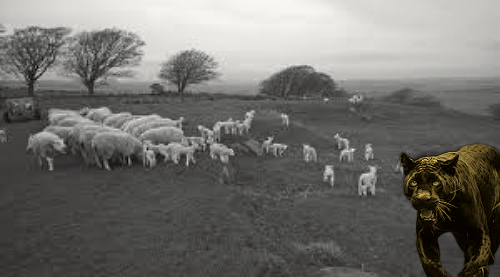
The Beast
As I cut the raw meat into chunks I think of my boy, who used to love watching me cook, waiting patiently at my feet for scraps – of food, or love. Maybe I didn’t give him enough. Maybe that’s why he went wild.
#
When I can’t put off grocery shopping any longer, I head out into the bright winter afternoon, finding the village full of tall tales of The Beast. Believed to be an escaped big cat, only a swish of black tail between fields, a glint of amber eyes on a rain-drenched road, has ever been seen. Unless you count the remains. Butchered and bleeding ino dirty fleece.
Doreen and Sandra are murmuring in the bread aisle, their blue-rinsed heads bowed together. I overhear them as I reach for a loaf.
“…Jack Robson’s daughter, Daisy,” Doreen says. “Found by the farm gate with her heart ripped out.”
Dread slips into my throat, its tentacles reaching downwards, seeming to fill my airways. I have to grab a shelf to stop myself falling.
When Sandra notices me, she shoots me a look half concerned, half judgemental.
“You should be careful, Helen, out there on your own.”
“I don’t think The Beast is interested in her, Sandra,” Doreen says. They hurry away, holding their noses as if to ward off a bad smell, to protect themselves from my taint.
Their whispers are lost under the thundering in my ears: bad mother, bad mother, like a train gaining momentum.
#
The rough-chopped steak leaves bloody trails on the plate, like those Daisy Robson must have left on the mud, I think. I wipe tears from my face and shuffle towards the back door. The plate shakes in my hand, the chunks threatening to slide off. The half-pane of glass fills with my reflection; my face old and hollowed. It’s too dark to see anything in the garden beyond, but I know he’s there, slinking through the trees separating my land from the farm’s. I always know.
I used to find him listening behind doors when I was arguing with his dad – and when we were making up. Once he came into the room when we were half-undressed; we must have forgotten to lock the door. Nothing was planned in those days.
“Dirty beast,” I yelled, shooing him away.
The day his dad left for good, my son watched intently: the car door slamming, the engine roaring, the cloud of dust on the lane. Then he turned his narrow cat eyes on me, no doubt hoping for a hug, or an explanation.
I couldn’t help him. My heart was in shreds. I shut myself in my room for two weeks.
#
After grabbing my groceries, weak-kneed and sickly, I head to the tea shop. Routine helps. Staying away from home as long as I dare does too.
I heap sugar into my cup, needing the energy to walk home. Needing to combat the shock with sweetness. Snatches of conversation float across to my table, trapped in thermals of frying meat. I used to love the aroma of bacon, but it sickens me now. Give me the iron tang of raw flesh any time – it’s more honest, somehow.
It seems The Beast is all anyone is talking about here too.
“It were bad enough when it were just sheep.”
“She was only seventeen.”
“What was she thinking, wandering about alone after dark?”
“Such a sweet girl. Always helping stray animals.”
“Aye, but it drove her mam mad, though.”
I watch their mouths work through sausage butties and toasted teacakes as they talk. I know they’re watching me too at times, sneaking looks with greasy eyes.
Then Gilly, laden with dirty plates, knocks my table with her hip and my tea slops onto the formica. The tepid wetness of it drips onto my legs.
“I’m sorry, Mrs B, I’ll bring you another one,” she says, mopping at my slacks with a dirty tea towel.
“That’s ok, don’t bother,” I reply, gathering my shopping bags.
It’s time to go, whether I like it or not.
#
It’s getting dark by the time I’m walking home, my shopping bags cutting into my hands. Bare hedges rise high on either side of the gravel lane; shadows of birds flit through the naked branches. When they go silent, I stop hard.
He’s in the field. I know it, despite there being no sound: his presence fills the smoky air.
I start walking again, picking up speed, my cottage maybe ten minutes away. Ahead, where the road bends, a growl shudders out of the shadows.
The Boy
I thought she’d be nice to me, Daisy. She was pretty and kind to stray things. Feeding the farm kittens from bottles, like she was their mum.
My mum always did whatever she wanted. Didn’t give a shit about me. After she drove Dad away, there were other men, but they never lasted long. She always blamed me, said that with me clinging onto her she was damaged goods.
I don’t think she ever wanted me at all. I heard her say to Dad once that I was a mistake.
I never thought Daisy would be so cruel. That’s why I liked her, I s’pose. She was so soft, and she smelled like fresh shampoo. I wanted to talk to her, I used to have endless conversations with her in my room, but if I ever saw her, in the village or walking along the lane, I’d freeze. I didn’t know what to say, so I said nothing.
I used to watch her, though, through a crack in the barn door, tending to the lambs, or playing with the kittens. She was always gentle, never harsh.
Until she found me. Spying on her, was the way she put it. Said it gave her the creeps. She actually looked scared. I told her not to worry and stroked her arm, trying to comfort her, but she screamed, and I ran into the woods, where I’ve been ever since.
I didn’t want to go home. Daisy would tell her dad, who’d tell my mum, then there’d be an almighty bollocking. So I survived as best I could, on berries and scraps. Until I got strong, so strong the lambs were easy to catch. And the farm could spare a few. My nails curved into claws, my teeth became long and sharp, I grew a coat to stay warm.
I grew.
As for Daisy, I didn’t mean to hurt her. I just wanted to see her again. I thought she might prefer me this way: females are supposed to love powerful males.
But she called me a monster. She shouldn’t have done that.
#
I hesitate on the threshold, the bloody meat smell filling my nostrils. I’d gotten home unscathed – I think he just likes to frighten me sometimes. Show me he’s changed. That he could tear me apart, if he chose.
I have to accept that I created this mess and now all I can do is keep his belly full and hope that stops the killing. He didn’t eat Daisy though, not a sliver. I fear that the slaughter was sport, in the way of cats, how they torment mice before ripping them open. Or perhaps it was something entirely more human: revenge.
The frigid air is a penance on my wet face, biting. My boots slip in mud as I fight my way to the middle of the garden. I place the plate on a flat stone, step back, scanning the bushes. At once hoping for and dreading a glimpse of his stealthy majesty. He’s beautiful now.
Perhaps he always was.
The bushes rustle. A deep purr has every blade of grass vibrating. I smell old meat in the air. I back up towards the cottage door, duck inside. This night, I find I’m too scared to catch sight of that lustrous dark fur, those night-bright fangs, those huge killing claws.
I’m scared I’ll be tempted to reach out and touch those whiskers, look into those tormented amber eyes and tell him it might still be okay, if only he stops now.
I might tell him that although he’s an animal now, a terrible killer, deep down he’s still my boy. I’m scared he’ll know that’s a lie and the chunks of steak won’t be nearly enough to sate him.
That this night, we’ll both learn who The Beast really is.
Madeleine won the Hammond House international short story prize in 2023, and has been published by Flash Fiction Magazine, The Hooghly Review, LISP, Moonflake and WestWord. By day she’s a journalist covering the pharma industry, and lives in south-east London with her husband, son and two cats. You can find her on Twitter/X: @madeleine_write and Bluesky: @madeleinewrite.bsky.social
Read more from Madeleine:
WestWord – ‘Surrey League, Match Four, Lloyd Park’
Flash Fiction Magazine – ‘Blood is Murkier Than Water’
 TRASH CAT LIT