Spring General Issue – Preloved Stories
Following the launch of each of our issues, we cajole one or more of the contributors into a mini interview with the Trash Cat.
Here they will reveal some writing wisdom and tell you what trash critter they identify with most. Important stuff like that.
Today, we have Jaime Gill.
You can read his imaginative and intense flash, This Is Not a Horror Film But if it Were… HERE
Q: What piece of writing advice/ crafting rule would you trash?
A: Show, don’t tell. It sometimes seems like this is the only rule many writers remember from their writing books or classes, and it’s often wielded like a cudgel, both in their own writing and their feedback to others. I’d rather read “Daniel approached the lion’s den, swallowing his terror” than “his breath shivery and shallow, the hairs on his arm rising, his heart thudding in his chest like a drumbeat, Daniel walked step by step towards the lion’s den.”
But I have honestly read many sentences like that last one when reading for literary magazines or contests. Writing is storytelling, and telling can be an extremely effective tool for moving a story along at a brisk pace and leaving time to show more interesting matters. Show more than tell? That’s a good rule. I suppose the bigger lesson here is that all writing rules should be treated as writing suggestions. Learn them, understand them, throw them overboard whenever they’re sinking or slowing your story.
Q: Which writers and magazines do you go to to find treasure to read?
A: I’ll restrict myself to modern and short form writers, or we’ll be here all day. I revere Kate Folk, I think her stories are dark wonders that could only have been written in the 21st century – I wish the same could be said of all mine. In flash, I admire Emily Rinkema’s work enormously, she can sculpt a very small amount of words into a blade and either subtly skin you with it or just shove it right through your heart. And I am good friends and an occasional collaborator with Charlie Rogers. I reached out to him when I was thrilled to discover a queer writer with such a gift for capturing the subtle ways in which humans interact, and who seems to write great sentences like other people breathe. In magazines, I love The Forge, Florida Review, London Magazine, Clarkesworld, Elegant Literature, and Oyster River Pages, though I’ve discovered that there are few magazines that don’t shelter at least a few wonderful writers.
Q: What trash animal do you most identify with?
A: As a writer, I’m trying to think of myself like a peacock. This idea started when I was lucky enough to meet one of my favourite writers, the astonishing British novelist David Mitchell. I asked him for one word of writing advice and he told me to be pavonine. I smiled, inwardly panicking, then later looked it up and found it means peacock-like. It actually bothered me for a long time, because I like linguistic restraint and find stories that seek to dazzle with every clause exhausting and a bit masturbatory. But then I remembered that male peacocks don’t actually walk around constantly in display mode. It’s inefficient. To get around they lower their tail feathers and look a little drabber, with glitzy displays reserved for special occasions. That’s now how I try to approach writing: a bit of shuffling through plot with occasional bursts of linguistic flamboyance.
Q: When your writing mojo is trashed, how do you recharge?
A: Often editing. I’m much more of an editor than a writer, as anyone who has read my rambling, dreary first drafts will agree. And I find editing is a good use of time when your creative muscles are exhausted. But I do also love soaking up fresh, inspiring art, and that could mean reading but it might just as easily mean movies, good TV (long-form TV right now is one of the most exciting art forms the world has ever known) and music. Music’s my biggest lifelong passion, and I’m trying to write more stories which capture the soaring or heartbreaking magic of songs. I’m even trying to experiment with writing stories that echo the ebbs, flows and repetitions of song structures. It’s not going well but I’ll keep at it.
Q: If you could offer three tips to writing short treasures, what would they be?
A: I think it varies for every writer and that’s as it should be, but I’d suggest all short writers need to do at least one of three things and ideally all.
1. Find a story you are excited to tell, which could mean something very high concept like an interactive alcoholism story I wrote or more intimate experience, something that moves you.
2. Find a character that interests you, which could mean a wonderful human you wish you were more like or a loathsome character that you want to understand .
3. Find the right moments, that can help you suggest a whole life in a very short space.
Q: What is one thing, if spotted in a crowded charity shop/thrift store, you would just have to buy
A: It would probably be a really striking painting, a book or – best of all – a vintage t-shirt. I have an original Nightmare On Elm Street t-shirt hanging up in my wardrobe right now. It’s so beautiful but it’s about three sizes too big for me. At least it will be a consolation if I lose my constant war against my expanding belly.
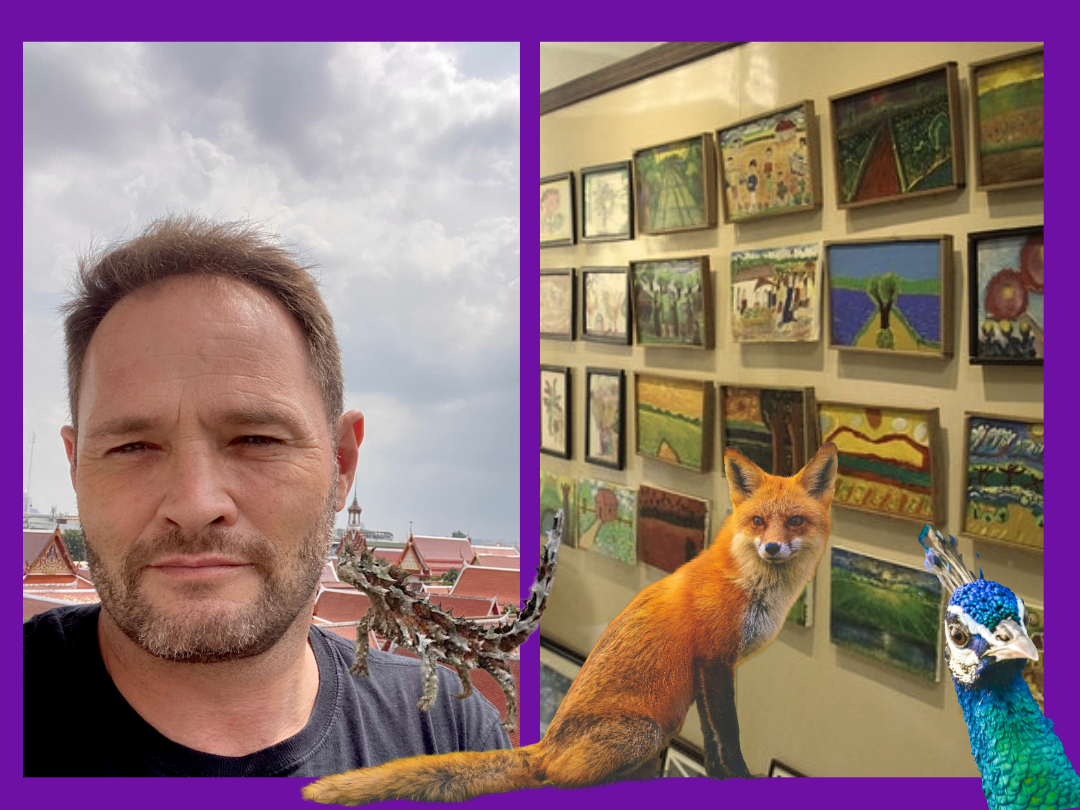
Jaime Gill is a British-born writer living in Cambodia, where he works and volunteers for nonprofits. He reads, runs, boxes, writes, and occasionally socialises. His stories have recently appeared in Missouri Review, The Forge, Fractured Lit, Trampset, and Hunger Mountain, winning awards including a Bridport Prize, Luminaire Prose Award, and New Millennium Writers Award. He has been a finalist for the Bath Short Story Award, Smokelong Grand Micro, and Oxford Flash Fiction Award and is a three-time Pushcart Prize nominee. He’s currently haphazardly writing a novel, script and yet more short stories. Website: www.jaimegill.com. Newsletter: https://jaimegill.substack.com/
 TRASH CAT LIT