We decided it’s about time
Each issue we cajole one or more of the contributors into a mini interview with the Trash Cat.
Here they reveal some writing wisdom and tell you what trash critter they identify with most. Important stuff like that.
Today, we have finally pinned down Trash Cat herself and asked that she tap into her wisdoms and reveal stuffs.
You’ll find links to her published work on her website: The Relphian
Q: What piece of writing advice/ crafting rule would you trash?
A: Advice, yes. Rules, hell no.
I’m not a fan of any of the well-used ‘rules for writing’: write what you know, don’t use too many adjectives (damn right I will), have a clear beginning/middle/end etc.
Write exactly what you want and then find the best home for it – which might be in your home, and only in your home, and that’s absolutely fine (I’m thinking of my murderprawn story here!).
If you want to develop your craft then get stuck into workshops and writing forums (particularly if they have feedback), and read and read and read.
Blend your genres, poetise your prose, mess with structure and form and chuck in some images. Find YOU. Your vibe, your tone, the thing that, when someone reads your work, makes them say “that’s classic [YOU]”.
Q: Which writers and magazines do you go to to find treasure to read?
A: Reading has gotten harder for me in the last couple of years (my health condition affects cognition and ‘staying power’.) I miss novels but if I can, I dip back into favourites I’ll try to read again and again. Robert McCammon introduced me to post-apocalyptic writing and werewolf stories, Dean Koontz’s older stuff has the best mix of realism and supernatural, Kathy Reichs and Patricia Cornwell satisfy my forensic mind.
For short fiction, I love to keep track of Trash Cat Lit contributors work, try to read their new publications. I also have collections by Lindz McLeod, Helen Whistbery, Anthony Neil Smith, SJ Townend and Kim Fu – which are all amazing to dip in and out of. Also the collections by my good friends, Sarah Royston and Mathew Gostelow. I recently read some of the flash in Split Lip Press and was blown away. Underbelly Press, Frazzled Lit and Bag of Bones also offer up fabulous fiction morsels.
Q: What trash animal do you most identify with?
A: While I am Trash Cat all the way, I also feel a certain kinship with rats. I admire their tenacity and, having once run a small pet rescue, their intelligence and affection. Like the raccoon though, I like a lot of naps and sweets and rummaging in bins (charity shops) looking for treasure. I also wear a mask, to a certain extent, but that’s another Q & A altogether.
Q: When your writing mojo is trashed, how do you recharge?
A: I frequently get writing slumps where even ideas are not forthcoming. It used to panic me, make me wonder if I’d simply run out of stories to tell, but I now accept a little burnout is normal and I always come back scribbling.
The TV is my recharger. If I am slumped in general, I’ll rewatch favourite shows and movies where less mental investment is needed. I also love some gripping true crime. Eventually, I’ll get pinged with an idea halfway through an episode of The Walking Dead and my notebook will be on hand. I might not write that story for some time, but the idea generation is always a sign my mojo is returning.
I do like a good generative workshop and often find I write things I’m sure I would never have come up with on my own. I’ve enjoyed several Martha Lane workshops (she nails the balance of info, prompts and writing sprints), and others by Meg Pokrass, Rosie Garland and Lindz McLeod got my flash juices flowing.
I’ve also found a return to Writers HQ and their weekly flash fiction challenge is a great way to commit to writing, as well as challenging myself to write under 500 words – which is way, like way harder than it used to be.
Q: If you could offer three tips to writing short treasures, what would they be?
A: These are the same for me as for Trash Cat Lit at this point!
1 – VOICE: establish your narrative voice for a specific piece and keep it consistent. Make it relevant to the story you are telling and make it such a compelling voice, the reader is left wanting more.
2 – REVEALS: If you are going to have a reveal/twist in the story – what I call a Ta-Da moment – don’t leave it until the end. Flash fiction isn’t an episode of TV where you can leave the viewer on a cliffhanger because all will be resolved next time. For me, I am left disappointed and a little cheated if the story isn’t resolved satisfactorily in the words you have used. Bring your reveal further up in the story, give the reader a few lines or a paragraph to see how the characters react/ respond. Don’t just write to shock at the very end.
3 – CHARACTER: I’m a sucker for good characterisation. I want to know the colour of their hair and eyes, what they’re wearing (I’m a very visual reader). Your character can be good or bad, hilarious or horrifying, but I want to be able to see them and get a sense of their feelings, their motivations, their desires, their fears. Whatever it may be, I want to be immersed in them for just a while.
Q: What is one thing, if spotted in a crowded charity shop/thrift store, you would just have to buy
A: Oh boy. I have lots of things, stuffs, collections. Marie Kondo is not welcome in my house – I get joy from all of it! I like being surrounded by items that have been gifted to me, found on holidays or are preloved delights.
So…vintage earrings and brooches; books on forensics, fungi, botany, insects, microbes, true crime; cat trinkets; embroidered clothing; weird plush; beautiful old glass; jugs and conserve pots; CDs (for the car); scarves; dresses and tops with cats, dinosaurs, weird dark stuff or beautiful florals. I also collect Giant Microbes, have an unhealthy (unless you’re a writer, right?) number of notebooks, and am a sucker for anything with a William Morris print.
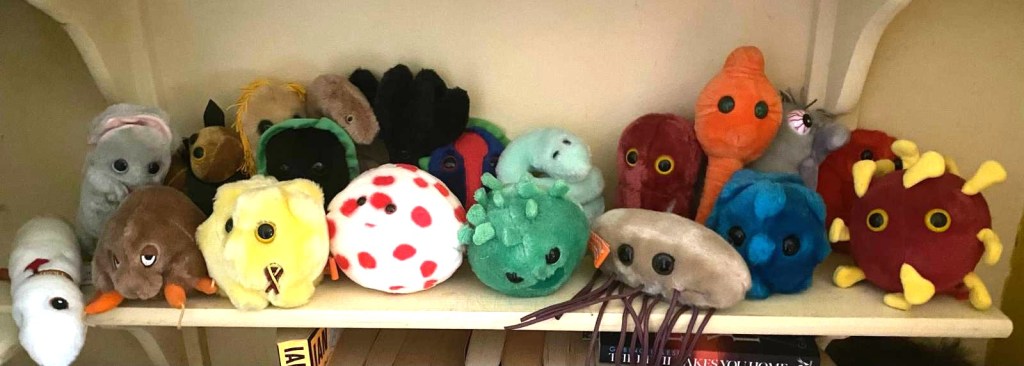
(my Dad likes to gift me a pathogen every Christmas…)

JP Relph is a Cumbrian writer hindered by three cats. Tea helps, milk first. She mooches around in charity shops looking for haunted objects. JP writes about apocalypses a lot (despite not having the knees for one) and her collection of post-apoc short fiction was published in 2023. She recently got a zombie story onto the Wigleaf longlist, which may be the best thing ever. Never ask about “the novel”, her eyes will roll right out her head.
 TRASH CAT LIT