Spring General Issue – Reprints
Following the launch of each of our issues, we cajole one or more of the contributors into a mini interview with the Trash Cat.
Here they will reveal some writing wisdom and tell you what trash critter they identify with most. Important stuff like that.
Today, we have triple repeat bin offender, Adele Evershed. We love her writing so it seems fitting that Trash Cat ask her the big Qs.
You can read Adele’s powerful flash fiction, I Made a Wish Jumping Rope HERE
Q: What piece of writing advice/ crafting rule would you trash?
A: I came to writing relatively late in life so all my ideas on ‘rules’ have been picked up in a very ad-hoc way rather than in an MFA classroom. In my day-to-day life I’m a rule follower – I’m a teacher after all – but in my writing I’ve found not knowing the formal rules has been freeing.
I began writing poetry which I love for its flexibility and opportunity to experiment with accepted conventions. Use a noun as a verb? Absolutely. Making up your own word for depression? Go for it. Have a sentence with no noun or verb? Why not? Flash fiction offers a similar freedom. Forms like hermit-crab or list stories embrace the unconventional, allow you to take risks and break rules.
Writing without the pressure of “doing it right” opens up new creative possibilities, and I’ve found that those risks are often the ones that lead to the most exciting and unexpected outcomes. But one rule I try to follow is Stephen King’s 10% rule—whenever I finish a piece of writing I try to remove at least 10% of the words.
Q: Which writers and magazines do you go to to find treasure to read?
A: I’m a huge fan of Tana French for her murder mysteries set in Ireland, Octavia Butler for making me like sci-fi, and Zadie Smith for anything she writes. For a quick flash fiction fix, I love browsing Smokelong, Free Flash Fiction, Janus Lit, Grey Sparrow Journal and of course, Trash Cat Lit.
I read a lot of poetry too. For Christmas I asked for subscriptions to Rattle and Frogpond, the journal from the Haiku Society of America. Online I always scroll through Thrush Poetry (which sadly just announced its closure) and Gone Lawn for their experimental prose poetry.
Q: What trash animal do you most identify with?
A: I grew up on the South Wales coast so I’m going to say a seagull. There is a Welsh myth I’m particularly fond of, where Dylan, the God of the Sea, transforms three girls into seagulls, so they belong to both the land and sea. I’ve always loved that idea of belonging to two worlds. When you hear a seagull’s cry it often sounds like it’s protesting its lot. Given what is happening at the moment in the world I can definitely relate to their howling outrage – that, and we both love stealing someone else’s fish ‘n’ chips!
Q: When your writing mojo is trashed, how do you recharge?
A: When I need to recharge my writing mojo, I like to flick through fine art books or visit museums online. I choose one painting and brainstorm words and phrases evoked by the art. Sometimes I’ll research the artist’s life and create a fictional account based on what I’ve learned. This process helps me write about subjects I might not have considered otherwise.
If anyone is looking for their own inspiration, I highly recommend exploring the ekphrastic prompts from Rattle and Ekphrastic Review – you can even submit your efforts.
Q: If you could offer three tips to writing short treasures, what would they be?
A:
1 – As every word counts in flash fiction using unusual imagery or metaphors gives a big bang for your buck. Yes, you could say, ‘the pink sky’ but what if you said ‘the flesh-colored sky’ or ‘the bubblegum sky’ instead? These choices not only set a vivid scene but also evoke emotions quickly – ideal for flash where you have a limited space to make an impact.
2 – Keep a notebook for jotting down phrases, snippets of conversations, or even just interesting words. I once heard on the radio that Rod Stewart was filling in the potholes on his road, and that became the foundation for a poem about old age. Similarly, I came across the phrase “wet-felting” during a class I taught, and I later used it in a story to describe “the wet-felted night.” At the moment I’m looking for a way to use ‘flannelette’!
3 – In flash fiction, every element plays a significant role. While it probably goes without saying that you need a killer opening and closing, a title can do a lot of the heavy lifting too. A strong, evocative title can draw a reader in, hint at themes or tone, and give the story an extra layer of meaning without taking up any precious word count – in most cases the title is not included in the count, so take advantage of it.
Q: What is one thing, if spotted in a crowded charity shop/thrift store, you would just have to buy
A: I collect tea-cups, so any pretty Hammersley bone china cup would have me reaching for my purse and my husband running for the hills!
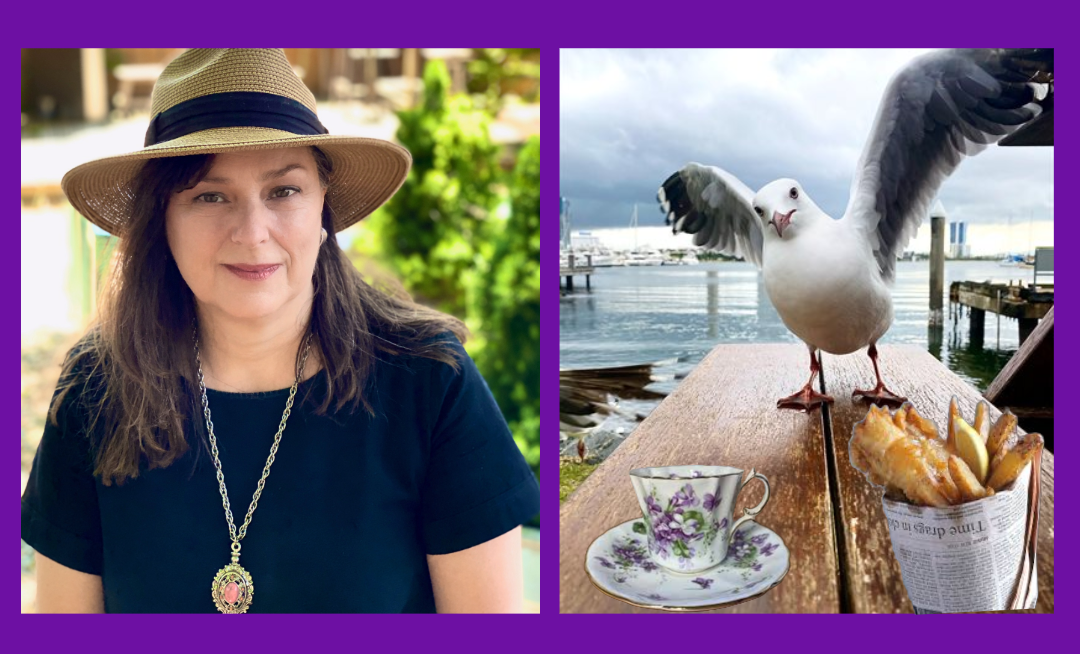
Adele Evershed is a Welsh writer who swapped the valleys for the American East Coast. You can find some of her poetry and prose in Grey Sparrow Journal, Anti Heroin Chic, Gyroscope, and Janus Lit, among others. Adele has two poetry collections, Turbulence in Small Spaces (Finishing Line Press) and The Brink of Silence (Bottlecap Press). She has published two novellas in flash, Wannabe and Schooled (Alien Buddha Press), and has a forthcoming novella, A History of Hand Thrown Walls, with Unsolicited Press. Her short story collection, Suffer/Rage, has recently been published by Dark Myth Publications.
 TRASH CAT LIT