Winter Pop-Up – Out of Place Animals
Following the launch of each of our issues, we cajole one or more of the contributors into a mini interview with the Trash Cat.
Here they will reveal some writing wisdom and tell you what trash critter they identify with most. Important stuff like that.
Today, we have repeat bin offender, Allan Miller.
You can read his delightfully deranged flash, Baboon HERE
Q: What piece of writing advice/ crafting rule would you trash?
A: I have a love-hate, like-dislike, ambivalence-distain, separation-reconciliation, marriage-divorce type of relationship with writing rules. I still see the rules, but only once a fortnight for an ice-cream and a trip to the park.
When I started noticing the term Flash Fiction I wondered if it was the name for what I was writing. A quick Google told me “there aren’t really any rules for writing Flash” but also “here are some rules for writing Flash”.
The first rule that I read, was to avoid any boring or unnecessary information, and to make every word count, starting with an opening sentence that will hook the reader. That kind of made sense, but as nearly all of my stories started with boring or unnecessary information, it knocked my confidence.
My thinking was that the boring details were the necessary information that would give the preposterous stuff more of an impact. After being told I needed to make all my words count and have the first sentence snap, crackle, and pop, my writing started to fizzle out.
Eventually, I realised it was a bit wanky to expect a reader to plough through 500 words of tedium before getting to the robotic sex minotaurs. However, I still like to write stories that start on the mundane side, so worrying about an opening that radiates with the power of a million suns doesn’t work for me.
Q: Which writers and magazines do you go to to find treasure to read?
A: On my bedside table you’ll find J.G. Ballard, H.P. Lovecraft, M.R. James, Clark-Ashton Smith, Algernon Blackwood, Ray Bradbury, Edgar Rice Burroughs, Ursula K. Le Guin, Ambrose Bierce (terrible person, but incredible short story writer) and Edward John Moreton Drax Plunkett aka Lord Dunsany. I keep their tiny shrunken forms trapped within a powerful amulet, but I treasure their writing too.
On the more contemporary end of things, I oft return to Chris McQueer’s short story collections, ‘Hings’ and ‘HWFG’, and Limmy’s ‘Daft Wee Stories’ and ‘That’s Your Lot’. They made me think there might be a readership for my attempts at humorous short fiction. I’m blown away by the quality of writing, and the range of ideas that feature in Gutter magazine, and there’s always something to savour in Extra Teeth, Postbox Magazine, and Lucent Dreaming. Unfortunately, a few literary mags I liked have folded. EllipsisZine was excellent, and it’s a bummer that you can no longer walk into a mainstream newsagents like WHSmith and pick up a copy of Popshot Quarterly. Fortunately, there are lots of cool online magazines. I dig the vibe of Neither Fish Nor Foul, and, of course, Trash Cat Lit. I get intimidated by anything po-faced or highfalutin, but they’ve got a sense of humour and publish the sort of off-the-wall stuff I enjoy. (Trash Cat Lit goes the extra mile for writers – one example being this Q&A.)
Q: What trash animal do you most identify with?
A: The week before Christmas I received the gift of a broken nose, smashed teeth, and two black eyes. I’d say you should see the other guy, but the other guy was a pavement, and was completely unscathed by my face-planting it from my son’s scooter whilst racing to pick him from school.
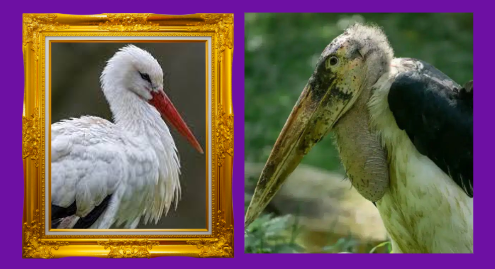
The trash animal I most identify with now is the Leptoptilos crumeniferus or Marabou stork – the ugliest of birds – it looks it has a scrotum for a face. It also lives in rubbish dumps eating trash, and I spend about 97% of my waking life tidying up after my son, although I draw the line at eating his discarded socks.
I should say that, despite my current physiognomy, my family have been very supportive. As long as I stayed confined to my quarters, where they couldn’t see me, they were more than happy to slide my Christmas dinner under the cellar door.
Q: When your writing mojo is trashed, how do you recharge?
A: I don’t get as much time to write as I would like (thanks in part to being a Leptoptilos crumeniferus), so writing is the thing I do to recharge. It’s my wild swimming or satsuma throwing. Having said that, switching off and doing something else is often the best way to fix a problem with a story. A resolution is more likely to come to me during a strolling willy-nilly in a cornfield than staring angrily at a blank screen, and some of my best work is done in the shower, despite the paper getting a bit soggy.
Q: If you could offer three tips to writing short treasures, what would they be?
A: Carrying on from the above, I’d say don’t worry if you can’t write every day, or only manage the occasional 20-minute splurge. Short story writing is suited to the short of time (and flash fiction is great for the even shorter of time, and micro-fiction is even greater for the even shorterer of time and, yes, shorterer isn’t a word). There is a benefit to having time constraints in that you don’t have the luxury of procrastination, or allowing your quill to dangle by your side for hours-on-end whilst adopting a pose of byronic anguish.
If, like me, you’ve got a mind like a sieve, then get into the habit of carrying a notepad. For some reason, just the act of having a notepad about my personage seems to switch on part of my brain that makes me more observant, or open to things that could feature in a story. You might not be able to use that fantastic stream of foul-mouthed abuse you overheard in the supermarket carpark right away, but jot it down and your notebook becomes a repository of sweary ideas for the future (or non-sweary ideas, if that’s your thing).
Don’t wait until you’ve got the start of your story to start writing. Get your idea down on the page. Sometimes it’s better not to start at the start anyway. Sometimes it’s better to write the ending, then work backwards. Sometimes the ending is the start. Just get it down, then you can go back and have fun adding in stuff and playing about with it.
Q: What is one thing, if spotted in a crowded thrift store, you would just have to buy?
A: I’ve made some impromptu/rash purchases over the years that I really regret – a monkey’s paw, a Victorian ventriloquist’s dummy, a haunted mirror, a Mogwai, a puzzle box that acts as a portal to a dimension of unbound pleasure and pain, a book written on human skin, a powerful amulet inside which are trapped the souls of great writers of horror, sci-fi and fantasy from the late 19th and early 20th century, and an air fryer.
So, the next time I’m in a junk shop, I’m going to place it safe and stick to shrunken heads. Having said that, I wouldn’t mind a painting of myself that’s a bit like the one in The Picture of Dorian Gray, but instead of the portrait getting increasingly deformed in correspondence with the subjects’ debauchery, I’d like a reverse version – a portrait of myself that stays exactly the same, whilst I grow old and ugly from a life of wanton excess. Although I do realise such a thing is probably a bit far-fetched.
Allan Miller is a writer based in Fife. His short stories and humorous flash fiction have been published in such places as Full House Literary, Firewords, Gutter, Porridge, Hooded, Popshot Quarterly, The Martello, Ellipsis Zine, Neither Fish Nor Foul and Trash Cat Lit.
 TRASH CAT LIT