Winter Pop-Up – Out of Place Animals
Following the launch of each of our issues, we cajole one or more of the contributors into a mini interview with the Trash Cat.
Here they will reveal some writing wisdom and tell you what trash critter they identify with most. Important stuff like that.
Today, we have Jo Clark, our invited Guest Reader & Contributor.
You can read her poignant, strange flash HERE
Q: What piece of writing advice/ crafting rule would you trash?
A: I can’t pick just one. I’d trash the whole lot and replace them with a simple guideline: there are (and should be) no rules that can hem in creativity. Grammar, punctuation and style as taught in schools are not rules, but conventions; be unconventional. Go as wild as you like – experiment, push the boundaries, use your imagination. It doesn’t apply to putting words on the page too – where else can you put words? What shape do those words need to take? Throw out the rule book, only listen to advice if it feels like something that will work for you. Writing is expression, it’s not rules.
Q: Which writers and magazines do you go to to find treasure to read?
A: I’m really disorganised in my reading and will read whatever is in front of me that intrigues me. Perhaps I should be more structured, but I’m just not. Stories that make me sit up are the ones that push hardest, subvert expectations without any contrived attempt at a ‘ta-da!’ moment; the ones that touch the heart or inspire the mind through a new perspective, told in a voice that compels me to listen and take notice. The only two loyalty cards I hold to lit mags are to voidspace, because their whole game chimes with my philosophy (see point 1) and always delivers surprising, delighting work; and to Trash Cat because I’d get torn to death by a hundred man-eating raccoons if I said otherwise, and because the whole Trash Cat philosophy of putting the contributor experience at the heart of things is something I am wholeheartedly behind – and it has already proven successful in terms of attracting stunning stories from a wide variety of writers.
Q: What trash animal do you most identify with?
A: As a friend of Trash Cat who often reads submissions, I’m officially known as Trash Badger, which we decided very early on is a skunk. That doesn’t mean I relate to a skunk – I don’t think I identify with any animal to be honest – but let’s face it, they have a bad press, and there’s no denying their visible cuteness… I’ve also never had to sit next to one on the bus, so I don’t have a personal grudge with them. I also have a big soft spot for badgers…
But – I think the animal that most enchants me are birds of prey – I find a hovering kestrel or a wheeling red kite irresistible; they always seem so joyous.
Q: When your writing mojo is trashed, how do you recharge?
A: I just stop trying to write. I don’t sweat it. I go for walks and immerse myself in nature, use my creativity in other ways – usually textile arts such as embroidery, knitting, crocheting. Read, or listen to audiobooks. I definitely don’t sit myself down and force myself to write; I’m not disciplined enough for that – which might go some way towards explaining why I can’t ever finish any of the longer writing projects I conceive and start! Eventually, and usually sooner than I expect, something will present itself in my head that I have to get down on paper (well keyboard…)
Q: If you could offer three tips to writing short treasures, what would they be?
A: Write the whole thing first without thinking about word count or polish. Just get the story out. This usually ends up meaning your way over the word count you’re aiming for, but at least it means you have included everything.
Sometimes the story that comes out isn’t what you thought it was going to be; put away your first draft for at least 24 hours, then come back and ‘excavate’ the real story. You may well be surprised by what the story actually is.
Once you’ve done that, you can start to home in on motifs and imagery threading through the narrative and start to excise the inevitable ‘flab’ from your first draft. It’s somewhere between finding the sculpture within a crude block of stone, and uncovering treasure in an archaeological dig. Let the process guide you.
I’m aware that’s not necessarily three separate tips, but I’ve already made it clear I’m undisciplined and a rule breaker. You can take each one separately if you like or interpret them as a cohesive note on what process works for me.
Q: What is one thing, if spotted in a crowded thrift store, you would just have to buy?
A: I once bought a haunted toy in a charity shop. One of my best writer buddies (tells me she) treasures it to this day. And I treasure a 1930s German Bakelite radio I impulse- bought over a quarter century ago in a junk store in Stockholm. But I think my favourite ever charity shop treasure was a hand-painted vintage darning mushroom. In addition to vintage crafting items – often for handicrafts that are half-forgotten – I’m drawn to beaten up vintage boxes, tins and trunks to store all my crafting stashes in.
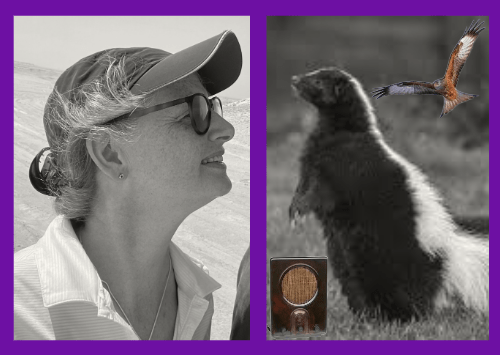
Jo Clark likes playing with words.
Some of them have been published, including in Splonk, Voidspace, and The Propelling Pencil.
 TRASH CAT LIT